Of These are claims by the holder and by Wikidata, read 2026-09-04, and join nothing until an editor confirms them.
Holder's headings Horses , Adam , Chariots , God the Father Close God Judging Adam — William Blake ca. 1795
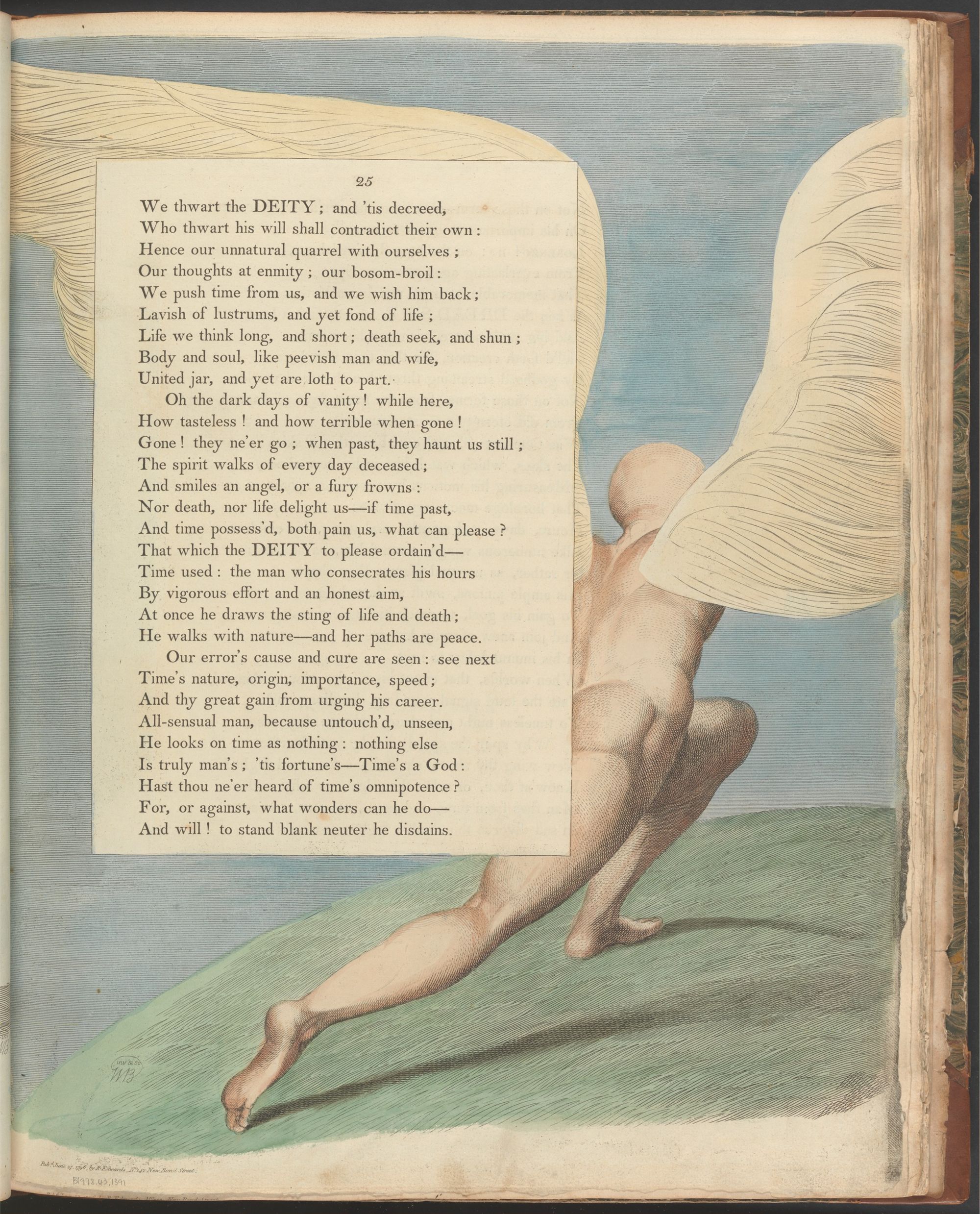
Also by William Blake 17 Songs of Experience: The School Boy William Blake[1789] printed ca. 1825 Metropolitan Museum of Art, New York, NY Songs of Experience: The Little Girl Found (second plate) William Blake[1789] printed ca. 1825 Metropolitan Museum of Art, New York, NY Songs of Experience: The Little Girl Lost William Blake[1789] printed ca. 1825 Metropolitan Museum of Art, New York, NY Songs of Experience: The Little Girl Lost (second plate); The Little Girl Found William Blake[1789] printed ca. 1825 Metropolitan Museum of Art, New York, NY 'Behold him, when past by; what then is seen' (Page 25) William Blakeca. 1797 Yale Center for British Art Songs of Experience: A Little Girl Lost William Blake[1794] printed ca. 1825 Metropolitan Museum of Art, New York, NY Songs of Experience: To Tirzah William Blake[1794] printed ca. 1825 Metropolitan Museum of Art, New York, NY Songs of Experience: My Pretty Rose Tree, Ah! Sun-Flower, The Lilly William Blake[1794] printed ca. 1825 Metropolitan Museum of Art, New York, NY
Within fifty years of ca. 1795 3342 Fragment Francec. 1750 The Art Institute of Chicago Drawing, Nude Domenico Corvi, Italian, 1721 - 1803ca. 1740 Cooper Hewitt, Smithsonian Design Museum Floral Design Unknown1740–70 Cooper Hewitt, Smithsonian Design Museum Title-page from Neüe Inventiones von Chinesischen Zierrathen, zu untershiedlichem Gebrauch, Erster Theil Bellay, French, active from 1734ca. 1740-1762 Cooper Hewitt, Smithsonian Design Museum Figural Letter V Unknownca. 1740 Cooper Hewitt, Smithsonian Design Museum Figural Letter N Unknownca. 1740 Cooper Hewitt, Smithsonian Design Museum Ornament Design Alexis Peyrotte, French, 1699–17691740–49 Cooper Hewitt, Smithsonian Design Museum Design for Tablet Carlo Marchionni, Italian, 1702–17861740–58 Cooper Hewitt, Smithsonian Design Museum
Also at Metropolitan Museum of Art, New York, NY 604 Marble female figure Bastis Master2600–2400 BCE Metropolitan Museum of Art, New York, NY Relief Fragment with a Ship Under Sail Unknownca. 2465–2458 BCE Metropolitan Museum of Art, New York, NY Tomb Chapel of Raemkai: South Wall Unknownca. 2446–2389 BCE Metropolitan Museum of Art, New York, NY West wall of the chapel of the mastaba Kaemsenu with niches for Iretnub, Kaemsenu and Werdjedptah Unknownca. 2420–2250 BCE Metropolitan Museum of Art, New York, NY Design amulet, Cow and Calf on the Back, Device showing Antithetical Falcons Flanking an Ankh Sign over a Crouching Lion Unknownca. 2150–2100 B.C. Metropolitan Museum of Art, New York, NY Design Amulet, Pyramidal Back with Horizontal Piercing, Device showing Two Falcons Flanking what is meant to be an Ankh Sign Unknownca. 2150–2010 B.C. Metropolitan Museum of Art, New York, NY Design Amulet, Cow Nursing Calf and also a Kneeling Suckling Man Visible on Opposite Side on the Back, Device showing Antithetical Falcons with an Ankh Sign over a Lion Unknownca. 2150–2100 B.C. Metropolitan Museum of Art, New York, NY Design Amulet, Back in the Form of a Woman Suckling a Child, Device showing Two Lizards Head-to-tail Unknownca. 2100–2080 B.C. Metropolitan Museum of Art, New York, NY In the stacks Not yet checked 2
Passages in the library’s own holdings that name this maker. The model ranked them; nobody has checked that the name means this person.
The Bases of Design · Walter Crane
At the end of last century a sort of revival took place under Thomas Bewick and his school, which led, not to a revival of the firm and open linear drawing of the designers of the early printers, but rather to a search after extra fineness and qualities of tone and colour, hitherto associated with steel or copper-plate. This tendency or aim of the engravers, however, only served to put the woodcut out of relation with the type, and the type itself grew uglier, and was hardly considered as part … 0.70 Of the Decorative Illustration of Books Old and New · Walter Crane
When he came to embody his own thoughts and dreams, he recurred quite spontaneously to the methods of the maker of the MS. books. He became his own calligrapher, illuminator and miniaturist, while availing himself of the copper-plate (which he turned into a surface printing block) and the printing press for the reproduction of his designs, and in some cases for producing them in tints. His hand-coloured drawings, the borderings and devices to his own poems, will always be things by themselves. His treatment of the resources of black and … 0.68 Add a connection Propose a reading
Next William Blake made God Judging Adam, and made these too.
Made in the eighteenth century, like God Judging Adam.