
Story of Samson and DelilahJudges 16:4-21
3 hands · 1528–1615
After this he loved a woman, who dwelt in the valley of Sorec, and she was…
Judges 16:4
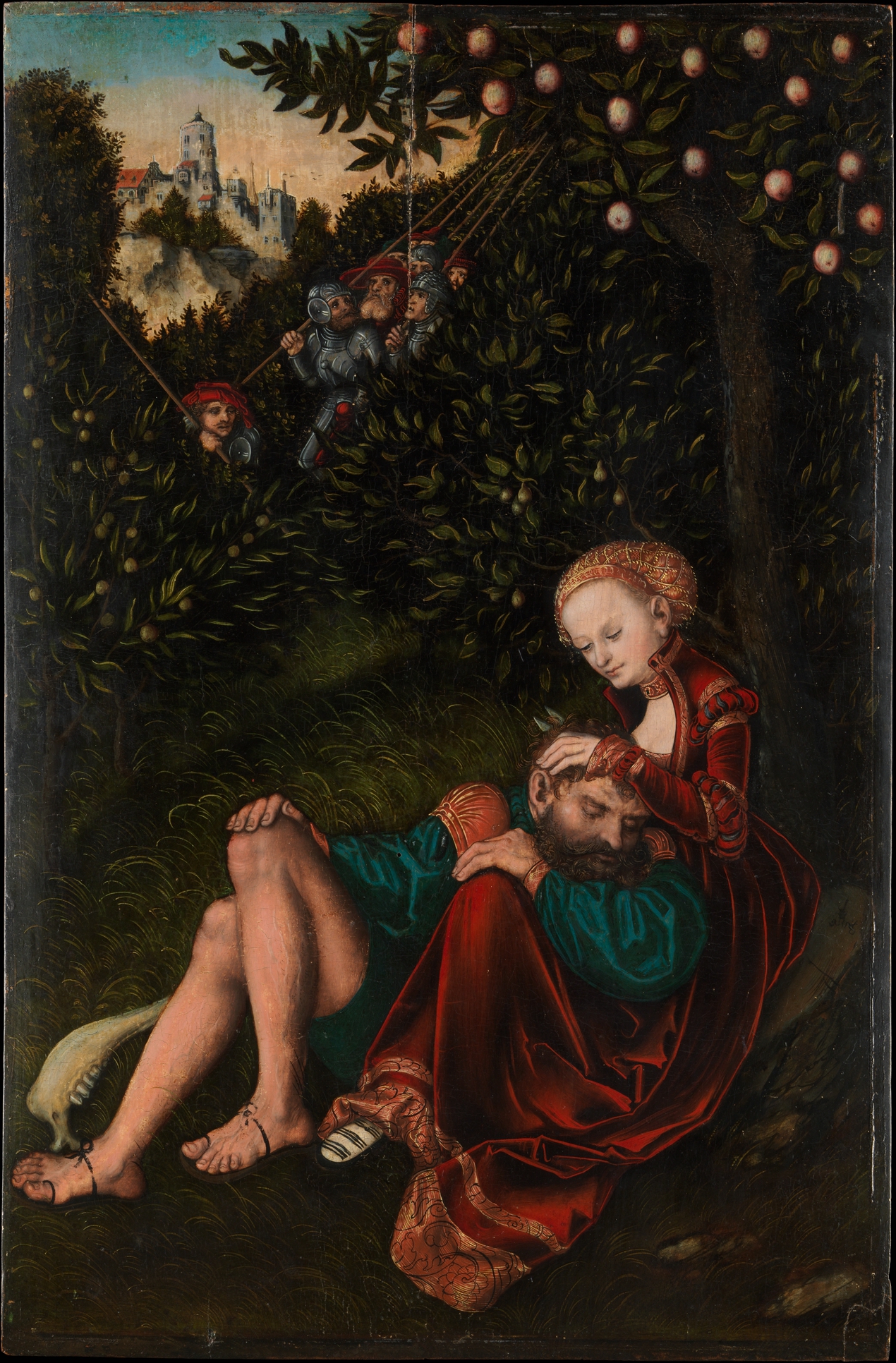
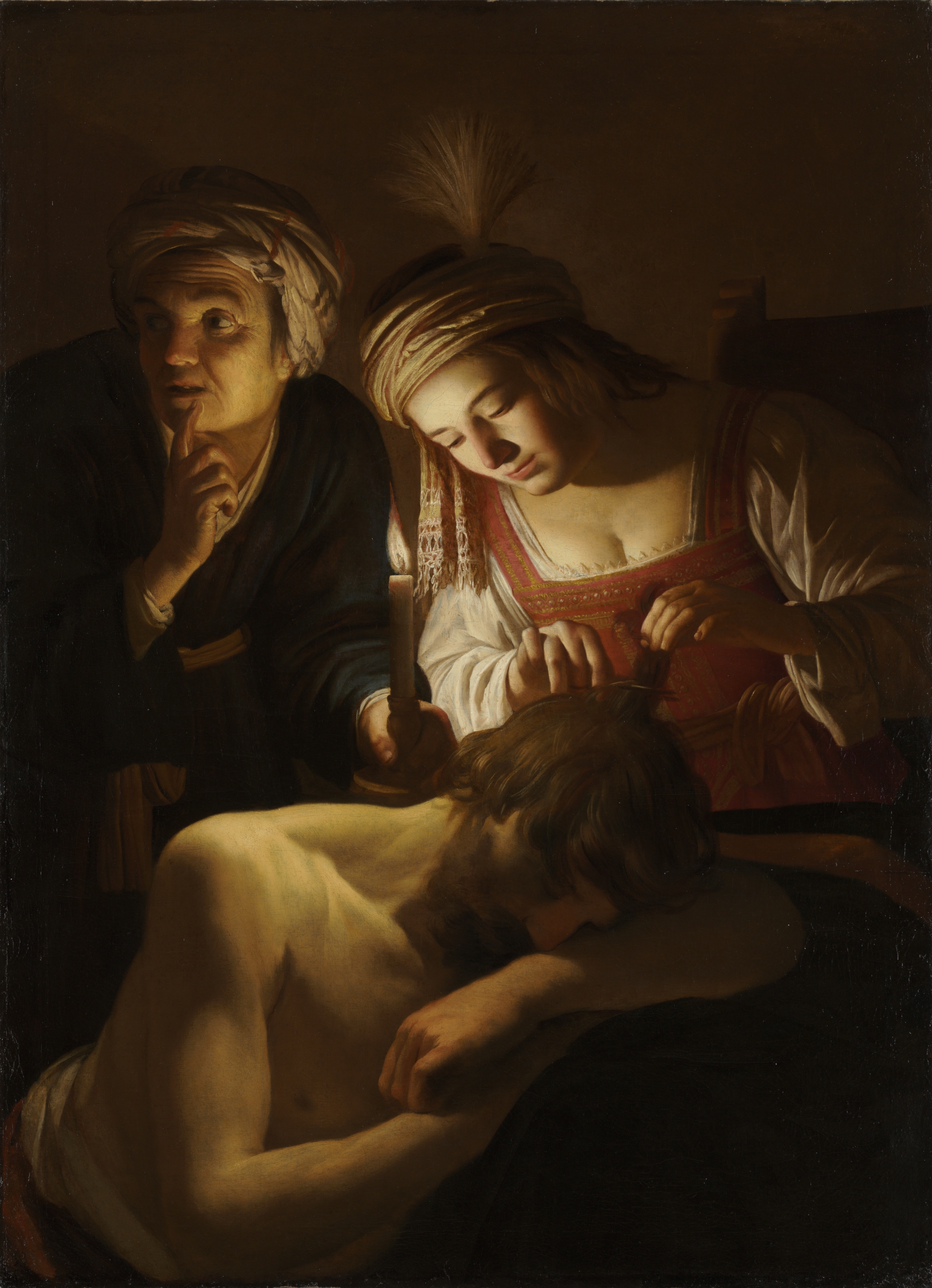
What it depicts
Judges 16:4-21Opened by a notation lookup, not by an editor. Iconclass 71F37 glosses this subject as “story of Samson and Delilah (Judges 16:4-21)”, and this library reads the Douay-Rheims, where the passage stands at Judges 16:4-21.
4After this he loved a woman, who dwelt in the valley of Sorec, and she was called Dalila.
5And the princes of the Philistines came to her, and said: Deceive him, and learn of him wherein his great strength lieth, and how we may be able to overcome him, to bind and afflict him: which if thou shalt do, we will give thee every one of us eleven hundred pieces of silver.
6And Dalila said to Samson: Tell me, I beseech thee, wherein thy greatest strength lieth, and what it is wherewith if thou wert bound thou couldst not break loose.
7And Samson answered her: If I shall be bound with seven cords made of sinews not yet dry, but still moist, I shall be weak like other men.
8And the princes of the Philistines brought unto her seven cords, such is he spoke of, with which she bound him;
9Men lying privately in wait with her, and in the chamber expecting the event of the thing, and she cried out to him: The Philistines are upon thee, Samson. And he broke the bands, as a man would break a thread of tow twined with spittle, when it smelleth the fire: so it was not known wherein his strength Jay.
10And Dalila said to him: Behold thou hast mocked me, and hast told me a false thing: but now at least tell me wherewith thou mayest be bound.
11And he answered her: If I shall be bound with new ropes, that were never in work, I shall be weak and like other men.
12Dalila bound him again with these, and cried out: The Philistines are upon thee, Samson, there being an ambush prepared for him in the chamber. But he broke the bands like threads of webs.
13And Dalila said to him again: How long dost thou deceive me, and tell me lies? Shew me wherewith thou mayest be bound. And Samson answered her: If thou plattest the seven locks of my head with a lace, and tying them round about a nail fastenest it in the ground, I shall be weak.
14And when Dalila had done this, she said to him: The Philistines are upon thee, Samson. And awaking out of his sleep he drew out the nail with the hairs and the lace.
15And Dalila said to him: How dost thou say thou lovest me, when thy mind is not with me? Thou hast told me lies these three times, and wouldst not tell me wherein thy great strength lieth.
16And when she pressed him much, and continually hung upon him for many days, giving him no time to rest, his soul fainted away, and was wearied even until death.
17Then opening the truth of the thing, he said to her: The razor hath never come upon my head, for I am a Nazarite, that is to say, consecrated to God from my mother’s womb: if my head be shaven, my strength shall depart from me, and I shall become weak, and shall be like other men.
18Then seeing that be had discovered to her all his mind, she sent to the princes of the Philistines, saying: Come up this once more, for now he hath opened his heart to me. And they went up taking with them the money which they had promised.
19But she made him sleep upon her knees, and lay his head in her bosom. And she called a barber, and shaved his seven locks, and began to drive him away, and thrust him from her: for immediately his strength departed from him.
20And she said: The Philistines are upon thee, Samson. And awaking from sleep, he said in his mind: I will go out as I did before, and shake myself, not knowing that the Lord was departed from him.
21Then the Philistines seized upon him, and forthwith pulled out his eyes, and led him bound in chains to Gaza, and shutting him up in prison made him grind.
Seen
Not yet checkedSuggested by an AI model, 2026-09-08 (hf.co/mradermacher/iconclass-vlm-GGUF:Q4_K_M), asked “Generate Iconclass labels for this image”. No one has checked these against the picture yet.
Of
The subjects are the library’s own joins, each marked with who made it. The other rows are claims by the holder and by Wikidata, read 2026-09-04, and join nothing until an editor confirms them.
- Subject
- Story of Samson and DelilahJudges 16:4-21joined by Abe Garcia
- Iconclass
- 71F377
- Holder's headings
- biblical, figures, interior, man, men, violence, woman, women
- Wikidata depicts
- Samson, Delilah
Means
No reading yet.
Rights
- Credit
- Robert A. Waller Memorial Fund. CC0.
- Licence
- CC0-1.0
- Evidence
- api.artic.edu artworks api: is_public_domain=true on artwork 8953 (read 2026-09-01)
- Record
- https://www.artic.edu/artworks/8953
- IIIF
- manifest
How this join was made
The Art Institute of Chicago gives this object the Iconclass notation71F377, and the library's map reads that notation as Judges 16:4-21. An editor has checked the picture against the passage and confirmed it.
Rubens' Capture of Samson: the hair already cut and the soldiers taking him, which is the end of the Delilah story.
Also by Peter Paul Rubens
14


Within fifty years of 1609–10
811




Also at The Art Institute of Chicago
762


Similar picturesFound by visual likeness
8 picturesVisual resemblances suggested by the model. A match does not establish a shared subject or historical connection.




In the stacks
Not yet checked3Passages in the library’s own holdings that name this maker. The model ranked them; nobody has checked that the name means this person.
The baroque antithesis to Raphael and Diirer is here represented by Rubens’ Christ Bearing the Cross* (engraving by Pontius with a variant anterior to the picture in Brussels). The recessional movement most brilliantly developed, and made still more interesting by an upward movement. The stylistically new factor we are looking for certainly does not lie in the merely material motive of the direction of movement, but, as it is a question of a principle of present- ment, in the way in which the theme is handled, how every recessional element
0.71PAINTING 75 tion. It is not a question of the degree of recession in the space represented, but in what way recession is made effective. Even where the seventeenth century apparently indulges in pure compositions in breadth, a closer com- parison must prove the fundamentally different point of departure. The spiral into-the-picture movement which Rubens loves will certainly be sought for in vain in Dutch pictures, yet this system of Rubens’ is only one type of re- cessional composition. There need even be no plastic oppositions of foreground and background:
0.70The course of the development of art, however, cannot simply be reduced to a series of separate points. Individuals fall into larger groups. Botticelli and Lorenzo di Credi, for all their differences, have still, as Florentines, a certain resemblance when compared with any Venetian, and Hobbema and Ruysdael, however divergent they may be, are immediately homogeneous as soon as to them, as Dutchmen, a Fleming like Rubens is opposed. That is to say: to the personal style must be added the style of the school, the country, the race. Let
0.69
Connections
Depicts
- Story of Samson and DelilahRubens' Capture of Samson: the hair already cut and the soldiers taking him, which is the end of the Delilah story.