A subject
Story of Samson and Delilah
Judges 16:4-211528–16153 hands
Opened by a notation lookup, not by an editor. Iconclass 71F37 glosses this subject as “story of Samson and Delilah (Judges 16:4-21)”, and this library reads the Douay-Rheims, where the passage stands at Judges 16:4-21.
After this he loved a woman, who dwelt in the valley of Sorec, and she was…
Judges 16:4
An editor has read 3 pictures against this passage and confirmed them.
3 hands, 1528 to 1615
The hands
3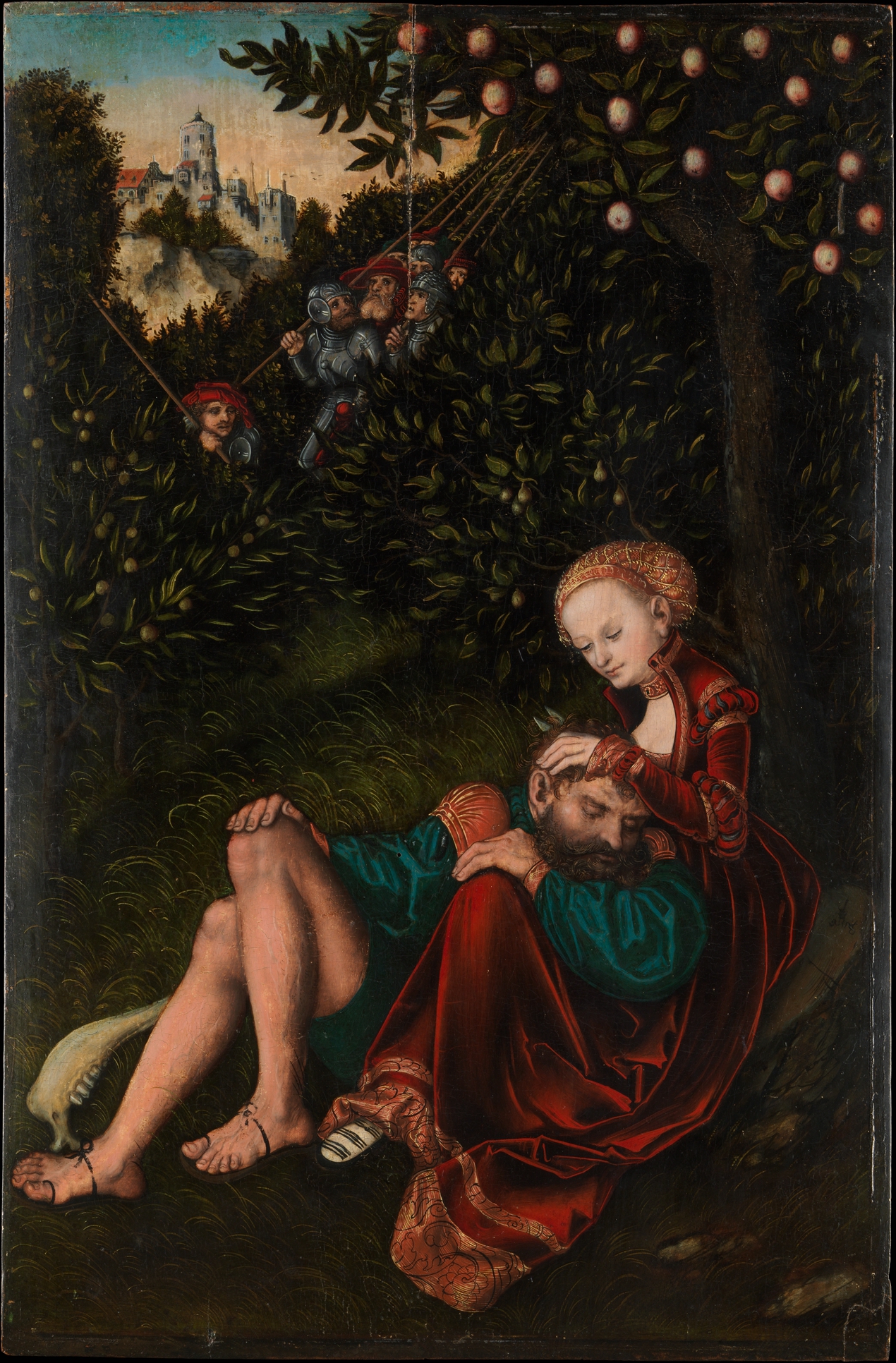
Lucas Cranach the Elderca. 1528–30Samson and DelilahBequest of Joan Whitney Payson, 1975. CC0-1.0 
Peter Paul Rubens1609–10The Capture of SamsonRobert A. Waller Memorial Fund. CC0.. CC0-1.0Rubens' Capture of Samson: the hair already cut and the soldiers taking him, which is the end of the Delilah story. 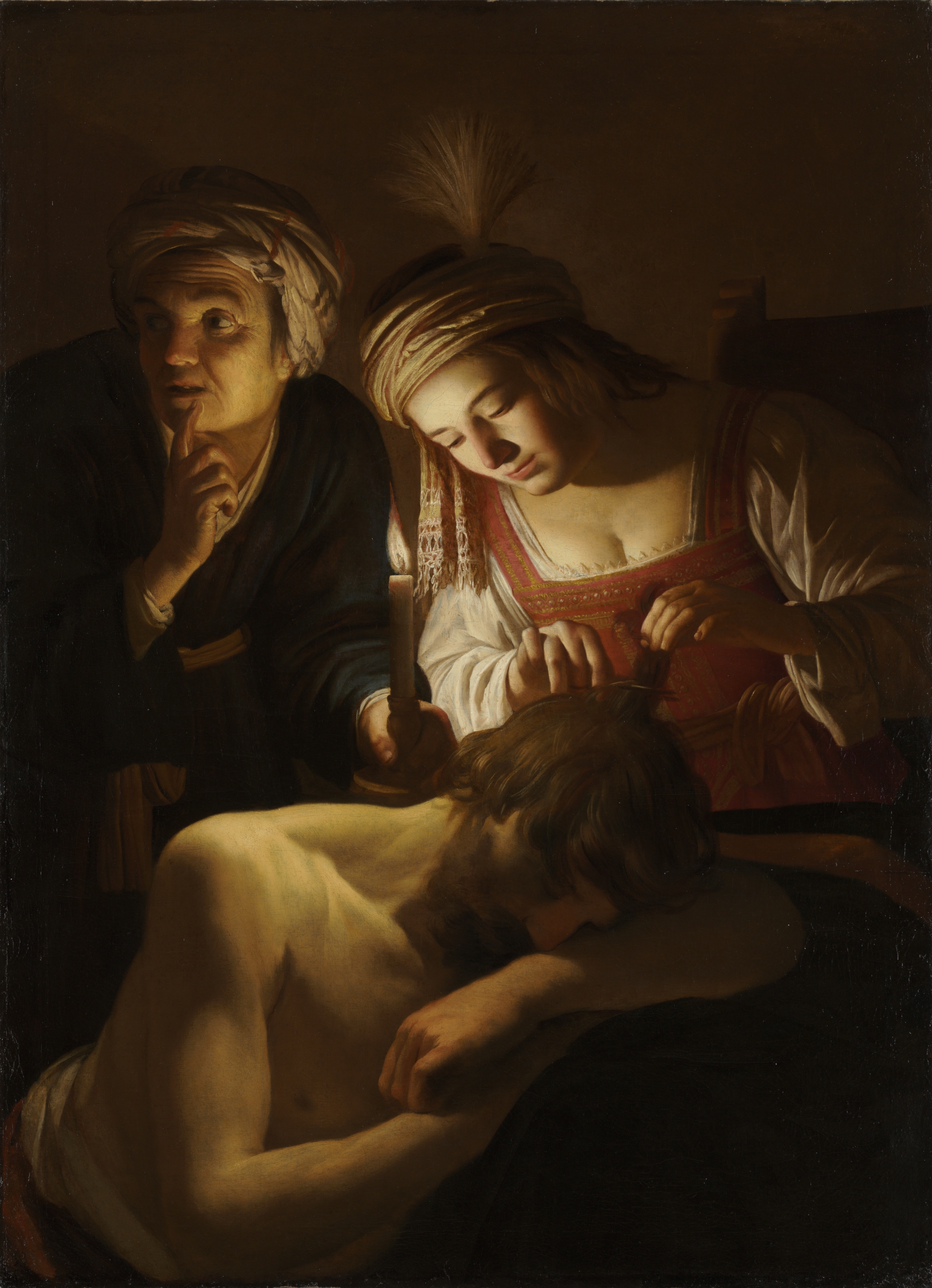
Gerrit van Honthorst (Dutch, 1590–1656)c. 1616Samson and DelilahMr. and Mrs. William H. Marlatt Fund. CC0-1.0
The passage
18 verses4After this he loved a woman, who dwelt in the valley of Sorec, and she was called Dalila.
5And the princes of the Philistines came to her, and said: Deceive him, and learn of him wherein his great strength lieth, and how we may be able to overcome him, to bind and afflict him: which if thou shalt do, we will give thee every one of us eleven hundred pieces of silver.
6And Dalila said to Samson: Tell me, I beseech thee, wherein thy greatest strength lieth, and what it is wherewith if thou wert bound thou couldst not break loose.
7And Samson answered her: If I shall be bound with seven cords made of sinews not yet dry, but still moist, I shall be weak like other men.
8And the princes of the Philistines brought unto her seven cords, such is he spoke of, with which she bound him;
9Men lying privately in wait with her, and in the chamber expecting the event of the thing, and she cried out to him: The Philistines are upon thee, Samson. And he broke the bands, as a man would break a thread of tow twined with spittle, when it smelleth the fire: so it was not known wherein his strength Jay.
10And Dalila said to him: Behold thou hast mocked me, and hast told me a false thing: but now at least tell me wherewith thou mayest be bound.
11And he answered her: If I shall be bound with new ropes, that were never in work, I shall be weak and like other men.
12Dalila bound him again with these, and cried out: The Philistines are upon thee, Samson, there being an ambush prepared for him in the chamber. But he broke the bands like threads of webs.
13And Dalila said to him again: How long dost thou deceive me, and tell me lies? Shew me wherewith thou mayest be bound. And Samson answered her: If thou plattest the seven locks of my head with a lace, and tying them round about a nail fastenest it in the ground, I shall be weak.
14And when Dalila had done this, she said to him: The Philistines are upon thee, Samson. And awaking out of his sleep he drew out the nail with the hairs and the lace.
15And Dalila said to him: How dost thou say thou lovest me, when thy mind is not with me? Thou hast told me lies these three times, and wouldst not tell me wherein thy great strength lieth.
16And when she pressed him much, and continually hung upon him for many days, giving him no time to rest, his soul fainted away, and was wearied even until death.
17Then opening the truth of the thing, he said to her: The razor hath never come upon my head, for I am a Nazarite, that is to say, consecrated to God from my mother’s womb: if my head be shaven, my strength shall depart from me, and I shall become weak, and shall be like other men.
18Then seeing that be had discovered to her all his mind, she sent to the princes of the Philistines, saying: Come up this once more, for now he hath opened his heart to me. And they went up taking with them the money which they had promised.
19But she made him sleep upon her knees, and lay his head in her bosom. And she called a barber, and shaved his seven locks, and began to drive him away, and thrust him from her: for immediately his strength departed from him.
20And she said: The Philistines are upon thee, Samson. And awaking from sleep, he said in his mind: I will go out as I did before, and shake myself, not knowing that the Lord was departed from him.
21Then the Philistines seized upon him, and forthwith pulled out his eyes, and led him bound in chains to Gaza, and shutting him up in prison made him grind.
In the stacks
Not yet checked4Suggested by an AI model from books the library holds but has not yet set as editions. A passage here is a place to read, not a citation.
Religious art in France, 13 century
FIG. 79.— FROM A SYMBOLIC WINDOW AT LE MANS (From Hue her) quote the Glossa ordinaria? Elisha is a type of Jesus Christ. When he learns that the widow's son is dead he first sends his servant with his staff to revive the child, but the servant lacks the divine power which will accomplish the miracle. This is an image of God's servant Moses who could not save the people, although God had given him a rod that 1 It is Elisha, and not Elijah to whom the Bible attributes
0.73Religious art in France, 13 century
It is not without reason that at Chartres, Amiens and Reims3 the statue of Solomon is placed near that of the queen of Sheba. In accordance with ecclesiastical doctrine this signifies that Solomon is a type of Christ and the queen of Sheba a type of the Church who came from the ends of the earth to hear the word of God.4 These are some of the more famous types of Christ in art. They are those to which the Middle Ages attached the most importance and represented with the
0.69Problems of mysticism and its symbolism
ANALYTIC INTERPRETATION 97 ambrosia, soma. We shall now see the wanderer ascend or descend to the source of this water of life. To gain the water of life it is generally in myths necessary to go down into the underworld (Ishtar's Hell Journey), into the belly of a monster or the like. Remember, too, that the wanderer puts himself back in his mother's womb. There is in- deed the origin of his life. The process is still more significantly worked out in the parable. The wanderer (Section n, after the
0.67Sacred and legendary art, volume 1 (of 2)
As the Angel who announced the birth of Christ, he has been venerated as the Angel who presides over childbirth. He foretells the birth of Samson, and, in the apocryphal legends, he foretells to Joachim the birth of the Virgin. In the East, he is of great importance. Mahomet selected him as his immediate teacher and inspirer, and he became the great protecting angel of Islamism: hence between Michael, the protector of the Jews and Christians, and Gabriel, the protector of the Moslem, there is supposed to exist no friendly
0.67
How this subject was made
The subject was opened by an Iconclass notation. The library's map reads 71F37, whose own gloss is story of Samson and Delilah (Judges 16:4-21)
, as Judges 16:4-21; a picture reaches this page when the notation a cataloguer put on it resolves here, whether the cataloguer wrote the notation down or wrote a subject heading that carries one. The authority is iconclass.org/71F37.
2 pictures Confirmed: the object's own title names the scene and the matched notation or heading is specific to it.
Connections
Painted
- Samson and Delilah1528Confirmed: the object's own title names the scene and the matched notation or heading is specific to it.
- The Capture of Samson1609Rubens' Capture of Samson: the hair already cut and the soldiers taking him, which is the end of the Delilah story.
- Samson and Delilah1615Confirmed: the object's own title names the scene and the matched notation or heading is specific to it.