
The massacre of the innocents and the flight into EgyptMatthew 2:13-23
2 hands · 1470–1503
And after they were departed, behold an angel of the Lord appeared in sleep to Joseph,…
Matthew 2:13
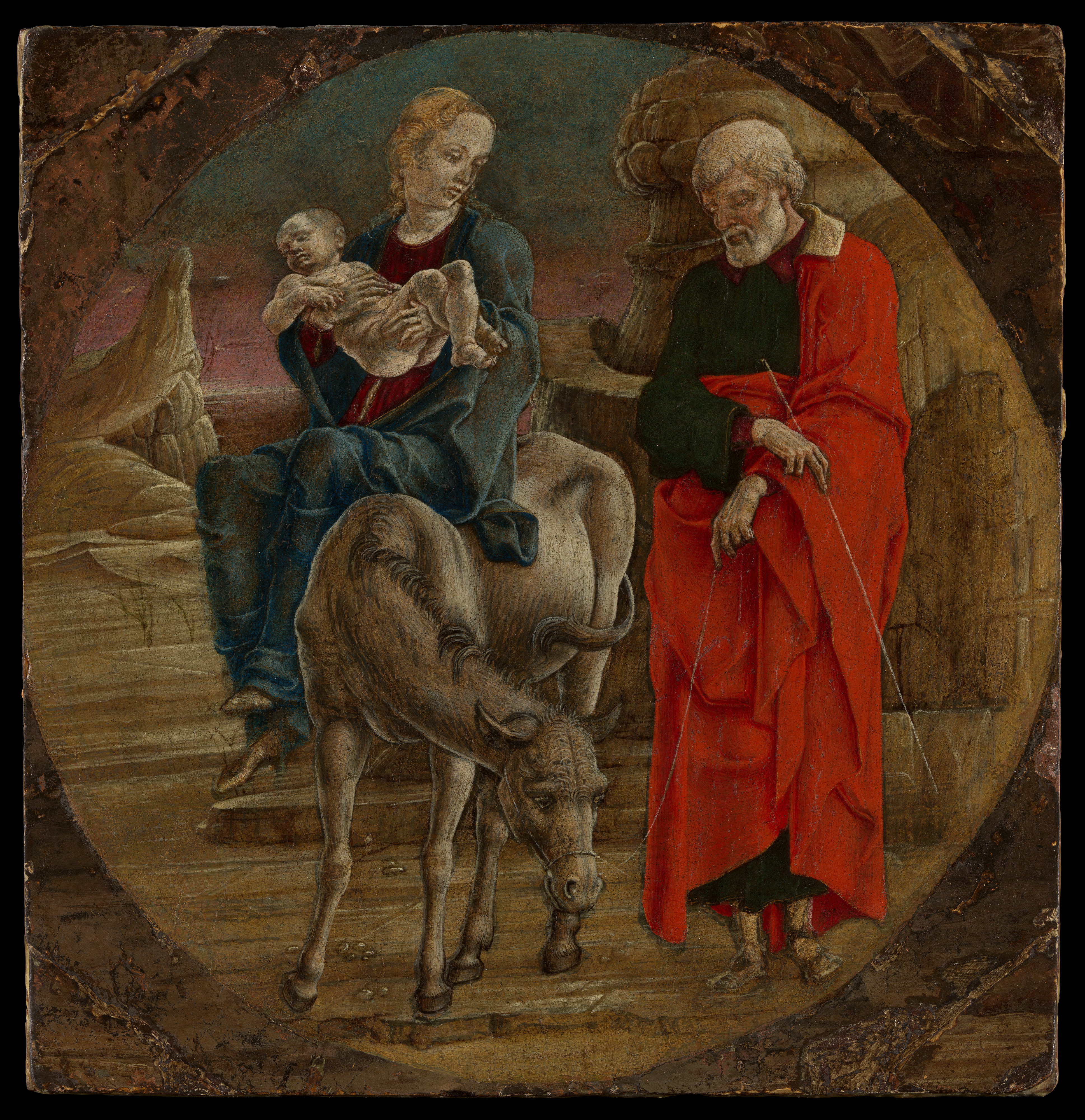
What it depicts
Matthew 2:13-23Opened by a notation lookup, not by an editor. Iconclass 73B6 glosses this subject as “the massacre of the innocents and the flight into Egypt (Matthew 2:13-23)”, and this library reads the Douay-Rheims, where the passage stands at Matthew 2:13-23.
13And after they were departed, behold an angel of the Lord appeared in sleep to Joseph, saying: Arise, and take the child and his mother, and fly into Egypt: and be there until I shall tell thee. For it will come to pass that Herod will seek the child to destroy him.
14Who arose, and took the child and his mother by night, and retired into Egypt: and he was there until the death of Herod:
15That it might be fulfilled which the Lord spoke by the prophet, saying: Out of Egypt have I called my son.
16Then Herod perceiving that he was deluded by the wise men, was exceeding angry; and sending killed all the men children that were in Bethlehem, and in all the borders thereof, from two years old and under, according to the time which he had diligently inquired of the wise men.
17Then was fulfilled that which was spoken by Jeremias the prophet, saying:
18A voice in Rama was heard, lamentation and great mourning; Rachel bewailing her children, and would not be comforted, because they are not.
19But when Herod was dead, behold an angel of the Lord appeared in sleep to Joseph in Egypt,
20Saying: Arise, and take the child and his mother, and go into the land of Israel. For they are dead that sought the life of the child.
21Who arose, and took the child and his mother, and came into the land of Israel.
22But hearing that Archelaus reigned in Judea in the room of Herod his father, he was afraid to go thither: and being warned in sleep retired into the quarters of Galilee.
23And coming he dwelt in a city called Nazareth: that it might be fulfilled which was said by prophets: That he shall be called a Nazarene.
Seen
Not yet checkedSuggested by an AI model, 2026-09-08 (hf.co/mradermacher/iconclass-vlm-GGUF:Q4_K_M), asked “Generate Iconclass labels for this image”. No one has checked these against the picture yet.
Of
The subjects are the library’s own joins, each marked with who made it. The other rows are claims by the holder and by Wikidata, read 2026-09-04, and join nothing until an editor confirms them.
- Subject
- The massacre of the innocents and the flight into EgyptMatthew 2:13-23joined by Abe Garcia
- Iconclass
- 73B641(+31)
- Wikidata depicts
- Holy Family
Means
No reading yet.
Rights
- Credit
- Dudley P. Allen Fund
- Licence
- CC0-1.0
- Evidence
- openaccess-api.clevelandart.org: share_license_status=CC0 on artwork 136178 (read 2026-08-27)
- Record
- https://clevelandart.org/art/1959.99.14
How this join was made
Cleveland Museum of Art gives this object the Iconclass notation73B641(+31), and the library's map reads that notation as Matthew 2:13-23. An editor has checked the picture against the passage and confirmed it.
Durer's Flight into Egypt, from the Life of the Virgin. The flight and the massacre are one subject here because Matthew 2 tells them as one event.
Also by Albrecht Dürer (German, 1471–1528)
15


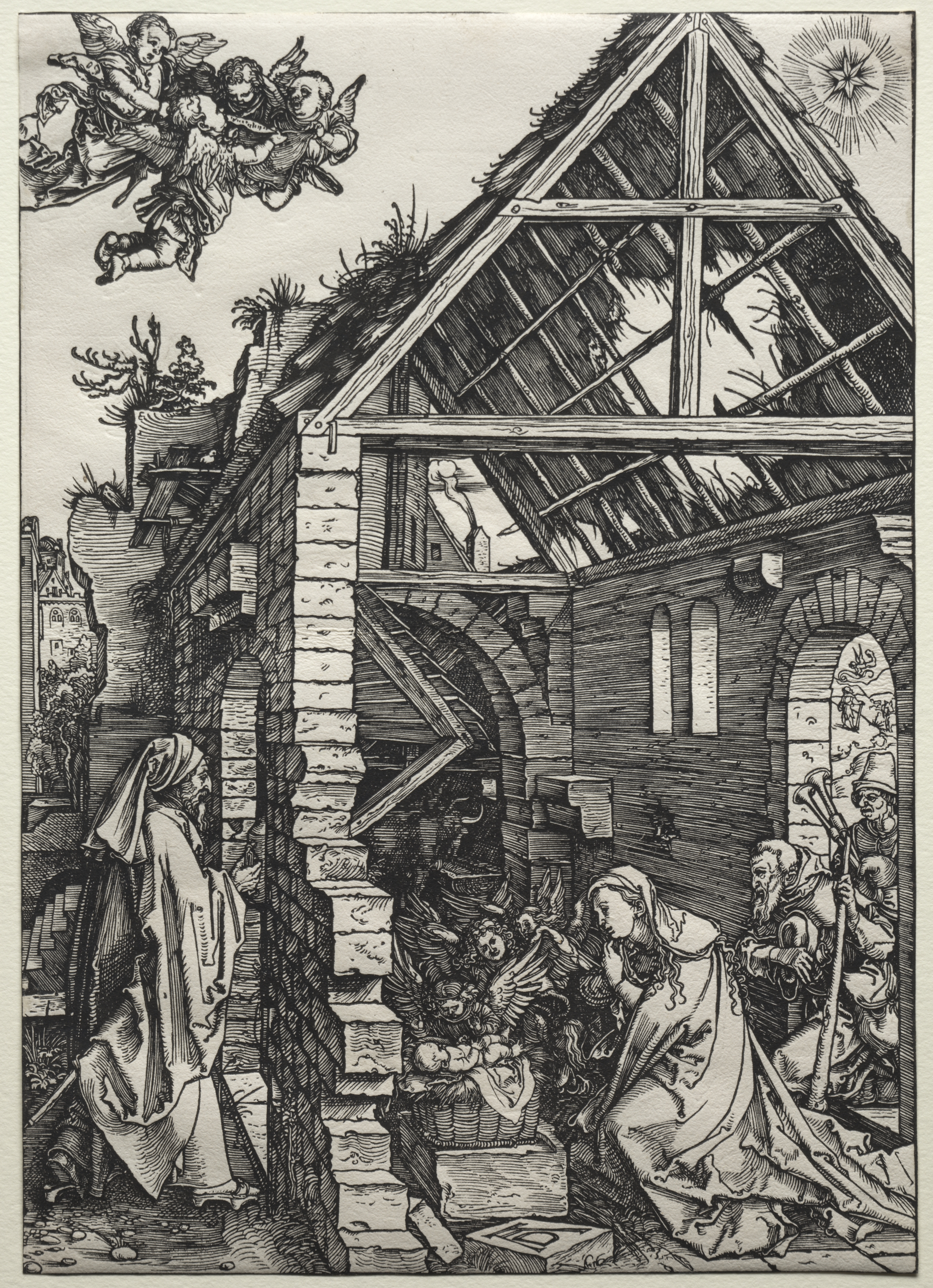

Within fifty years of c. 1503–5
350


Also at Cleveland Museum of Art
545


Similar picturesFound by visual likeness
8 picturesVisual resemblances suggested by the model. A match does not establish a shared subject or historical connection.



In the stacks
Not yet checked4Passages in the library’s own holdings that name this maker. The model ranked them; nobody has checked that the name means this person.
Drawing still retained something of the blunt, almost brutal frankness of statement, together with the sense of the characteristic which marked its earlier period. And it is perhaps this inheritance of Gothic directness of statement, this Gothic realism, that accounts for what is ultimately of most value in Dürer’s work. There exists in the Kunsthistorisches Akademie at Vienna a painting of a man, dated 1394, which shows how much of Dürer’s portraiture was already implicit in the Nuremberg school. In this remarkable work, executed, if we may trust the date,
0.73What, then, lies at the root of Dürer’s art is this Gothic sense of the characteristic, already menaced by the professional bravura of the late Gothic craftsman. The superstructure is what Dürer’s industry and intellectual acquisitiveness, acting in the peculiar conditions of his day, brought forth. It is in short what distinguishes him as the pioneer of the Renaissance in Germany. This new endeavour was in two directions, one due mainly to the trend of native ideas, the other to Italian influence. The former was concerned mainly with a new
0.72Up to the end of the fifteenth century the Gothic and ornamental feeling is still dominant in the treatment of the design of woodcuts in books, and most instructive and suggestive they are in simplicity of method and line, and directness of expression. Characteristic German work of Gothic feeling and considerable graphic force is seen in the woodcuts of the Nuremberg Chronicle (1493) designed by Michael Wolgemuth, the master of Albert Dürer. In these vigorous cuts we may plainly see the tradition of that Gothic feeling and style of graphic
0.72Dürer patterns do not coincide with objective facts, but for all that, they are lines, clear, ornamental patterns which are intended to be seen for themselves, which do not merely assert themselves in the impression of the whole but can hold their own even at the closest range. Therein lies the difference from the painterly foliage painting of the seventeenth century. If we wish to speak of premonitions of the painterly style, we shall find them rather in the fifteenth century than in the sixteenth. We find there, indeed, in
0.71
Connections
Depicts
- The massacre of the innocents and the flight into EgyptDurer's Flight into Egypt, from the Life of the Virgin. The flight and the massacre are one subject here because Matthew 2 tells them as one event.