A subject
Story of the denial of Peter
Matthew 26:581610–16242 hands
Opened by a notation lookup, not by an editor. Iconclass 73D33 glosses this subject as “story of the denial of Peter (Matthew 26:58, 26:69-75; Mark 14:54, 14:66-72; Luke 22:55-62; John 18:15-18, 18:25-27)”, and this library reads the Douay-Rheims, where the passage stands at Matthew 26:58. Iconclass states 4 references for this subject; the first one this corpus holds is used.
And Peter followed him afar off, even to the court of the high priest. And going…
Matthew 26:58
An editor has read 2 pictures against this passage and confirmed them.
2 hands, 1610 to 1624
The hands
2
Caravaggio (Michelangelo Merisi)1610The Denial of Saint PeterGift of Herman and Lila Shickman, and Purchase, Lila Acheson Wallace Gift, 1997. CC0-1.0Caravaggio's Denial of Saint Peter: the maid pointing, the soldier, and Peter's hands. The whole episode is three faces in the dark. 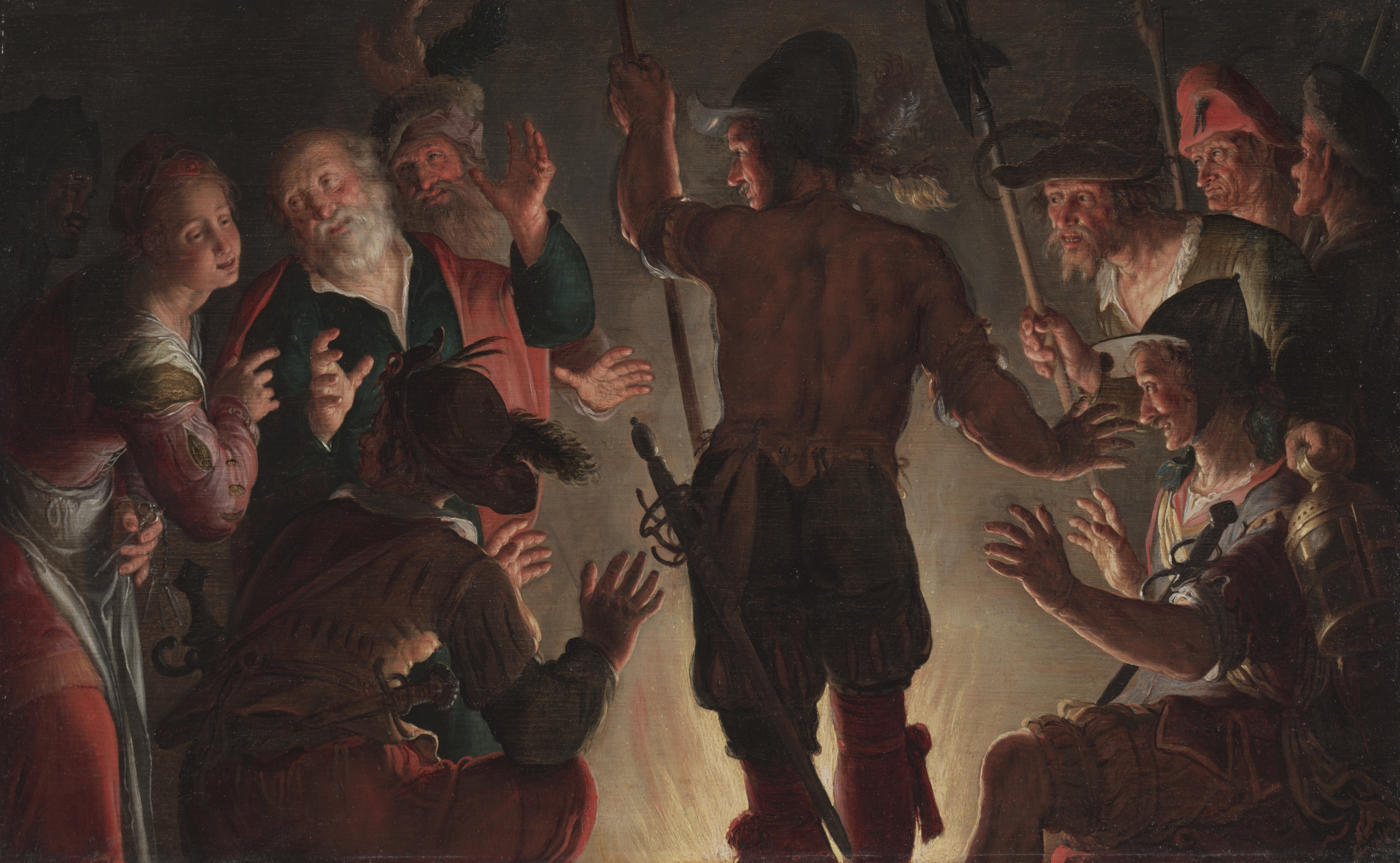
Peter Wtewael (Dutch, 1596–1660)c. 1624–28The Denial of PeterGift of Mr. and Mrs. Noah L. Butkin. CC0-1.0Confirmed: the object's own title names the scene and the matched notation or heading is specific to it.
The passage
1 verses58And Peter followed him afar off, even to the court of the high priest. And going in, he sat with the servants, that he might see the end.
In the stacks
Not yet checked6Suggested by an AI model from books the library holds but has not yet set as editions. A passage here is a place to read, not a citation.
Religious art in France, 13 century
Inconsolable for the loss of his magician, Nero had the apostles imprisoned in the Mamertine, but they converted their gaolers who thereupon set them free. Peter, fearing the death with which he was threatened, resolved to flee, and when without the walls of the city and arrived at the place where now stands the church of Santa Maria ad Passus, suddenly he saw Jesus Christ coming towards him. "Lord," said Peter, " whither goest thou ? " And He answered, " I go to Rome to be crucified anew." St.
0.72Religious art in France, 13 century
But Simon did not consider himself vanquished, and he strenuously endeavoured to raise to life a young man who had just died. But in vain did he pronounce his most efficacious formula? ; he could only cause him to move his head. Then the apostles drew near the bed, and St. Peter said, "Young man, in the name of Jesus Christ of Nazareth who was crucified, rise and walk." And the dead man arose and walked.4 Then the people murmured against Simon, and the magician declared that he would leave
0.68Renaissance in Italy, Volumes 6 and 7 (of 7)
On ignorance rests their power, and truth is mortal to them. Every vice of which humanity is capable, every frailty to which it is subject, finds from them support and consolation. If S. Peter had been directed by a Jesuit confessor he might have arrived at denying Christ without sin. The use the confessional as an instrument of political and domestic influence, reciprocating its confidences one with the other in their own debates, but menacing their penitents with penalties if a word of their counsel be bruited to the world.
0.67Sacred and legendary art, volume 1 (of 2)
* * * * * The legend which makes St. Peter the keeper of the gate of Paradise, with power to grant or refuse admission, is founded on the delivery of the keys to Peter. In most of the pictures which represent the entrance of the blessed into Paradise or the New Jerusalem, Peter stands with his keys near the gate. There is a beautiful example in the great fresco of Simone Memmi in the chapel _de’ Spagnuoli_ at Florence: St. Peter stands at the open portal with his great
0.66Religious art in France, 13 century
(chapel of St. Peter), at Sens (apsidal chapel, mutilated 4 Leg. aurea. De sancto Petro. De sancto and restored), at Poitiers (near the chevet), at Troyes Paulo. 296 OF THE THIRTEENTH CENTURY heard that St. Paul had raised from the dead his cupbearer Patroclus.1 But he was not convinced. The apostles had a formidable rival in the person of Simon the magician, who by means of his spells had gained great hold on Nero. Simon boasted that he could cause serpents of brass to move, make bronze statues to laugh
0.66Sacred and legendary art, volume 1 (of 2)
The Virgin and the Apostles seated; flames of fire stand on their heads; the Holy Ghost appears above in a glory of light, from which rays are poured on every side. Mary Magdalene, and another Mary, are present behind; astonishment is the prevailing expression in every face, except in the Virgin and St. Peter. The composition is attributed to Raphael.[156] * * * * * The next event of importance is the separation of the Twelve Apostles when they disperse to preach the Gospel in all lands. According to the
0.66
How this subject was made
The subject was opened by an Iconclass notation. The library's map reads 73D33, whose own gloss is story of the denial of Peter (Matthew 26:58, 26:69-75; Mark 14:54, 14:66-72; Luke 22:55-62; John 18:15-18, 18:25-27)
, as Matthew 26:58; a picture reaches this page when the notation a cataloguer put on it resolves here, whether the cataloguer wrote the notation down or wrote a subject heading that carries one. The authority is iconclass.org/73D33.
Connections
Painted
- The Denial of Saint Peter1610Caravaggio's Denial of Saint Peter: the maid pointing, the soldier, and Peter's hands. The whole episode is three faces in the dark.
- The Denial of Peter1624Confirmed: the object's own title names the scene and the matched notation or heading is specific to it.