A subject
From Pilate's palace to Golgotha: the procession to Calvary
Matthew 27:31-331489–15052 hands
Opened by a notation lookup, not by an editor. Iconclass 73D4 glosses this subject as “from Pilate's palace to Golgotha: the procession to Calvary (Matthew 27:31-33; Mark 15:20-22; Luke 23:26-33; John 19:17)”, and this library reads the Douay-Rheims, where the passage stands at Matthew 27:31-33. Iconclass states 4 references for this subject; the first one this corpus holds is used.
And after they had mocked him, they took off the cloak from him, and put on…
Matthew 27:31
An editor has read 2 pictures against this passage and confirmed them.
2 hands, 1489 to 1505
The hands
2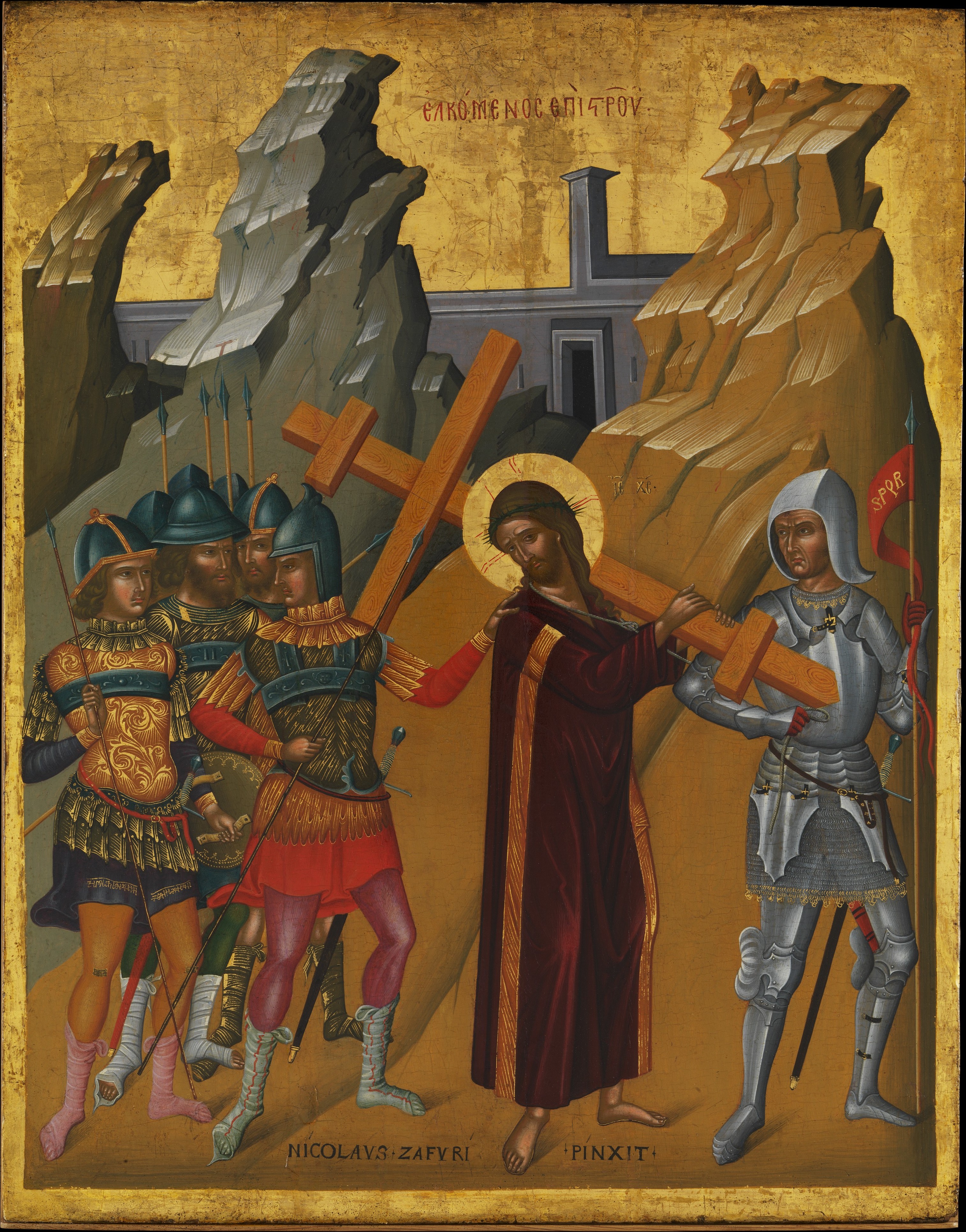
Nicolaos Tzafouris1489Christ Bearing the CrossBashford Dean Memorial Collection, Funds from various donors, 1929. CC0-1.0Confirmed: the object's own title names the scene and the matched notation or heading is specific to it. 
Hans Malerc. 1510Christ Carrying the CrossCharles H. and Mary F. S. Worcester Collection. CC0.. CC0-1.0Hans Maler's Christ Carrying the Cross, which is the road this subject covers, from the palace to the hill.
The passage
3 verses31And after they had mocked him, they took off the cloak from him, and put on him his own garments, and led him away to crucify him.
32And going out, they found a man of Cyrene, named Simon: him they forced to take up his cross.
33And they came to the place that is called Golgotha, which is the place of Calvary.
In the stacks
Not yet checked2Suggested by an AI model from books the library holds but has not yet set as editions. A passage here is a place to read, not a citation.
The Stones of Venice, Volume 2 (of 3)
HOSANNA IN THE HIGHEST: BLESSED IS HE THAT COMETH IN THE NAME OF THE LORD." And observe in this writing that the convert is required to regard the outpouring of the Holy Spirit especially as a work of _sanctification_. It is the _holiness_ of God manifested in the giving of His Spirit to sanctify those who had become His children, which the four angels celebrate in their ceaseless praise; and it is on account of this holiness that the heaven and earth are said to be full of His glory.
0.69Religious art in France, 13 century
But another idea of equal value seemed to him worthy of expression at the same time. By His death Jesus not only founded the Church, but abolished the authority of the Synagogue. At the very hour when He gave up His spirit on Calvary, the Jewish church with her sacrifices of blood which were symbols and with the Bible whose meaning she did not under- stand, faded away before the newly created church of Christ. From that moment the Church alone had power to celebrate the Sacrifice, and she alone
0.66
How this subject was made
The subject was opened by an Iconclass notation. The library's map reads 73D4, whose own gloss is from Pilate's palace to Golgotha: the procession to Calvary (Matthew 27:31-33; Mark 15:20-22; Luke 23:26-33; John 19:17)
, as Matthew 27:31-33; a picture reaches this page when the notation a cataloguer put on it resolves here, whether the cataloguer wrote the notation down or wrote a subject heading that carries one. The authority is iconclass.org/73D4.
Connections
Painted
- Christ Bearing the Cross1489Confirmed: the object's own title names the scene and the matched notation or heading is specific to it.
- Christ Carrying the Cross1505Hans Maler's Christ Carrying the Cross, which is the road this subject covers, from the palace to the hill.