A subject
Institution of the Eucharist, i.e. Christ showing or blessing bread (host) and/or wine
Matthew 26:26-2717191 hand
Opened by a notation lookup, not by an editor. Iconclass 73D244 glosses this subject as “institution of the Eucharist, i.e. Christ showing or blessing bread (host) and/or wine (Matthew 26:26-27; Mark 14:22-23; Luke 22:19-20; John 13:26; 1 Corinthians 11:23-25)”, and this library reads the Douay-Rheims, where the passage stands at Matthew 26:26-27. Iconclass states 5 references for this subject; the first one this corpus holds is used.
And whilst they were at supper, Jesus took bread, and blessed, and broke: and gave to…
Matthew 26:26
An editor has read one picture against this passage and confirmed it.
The hands
1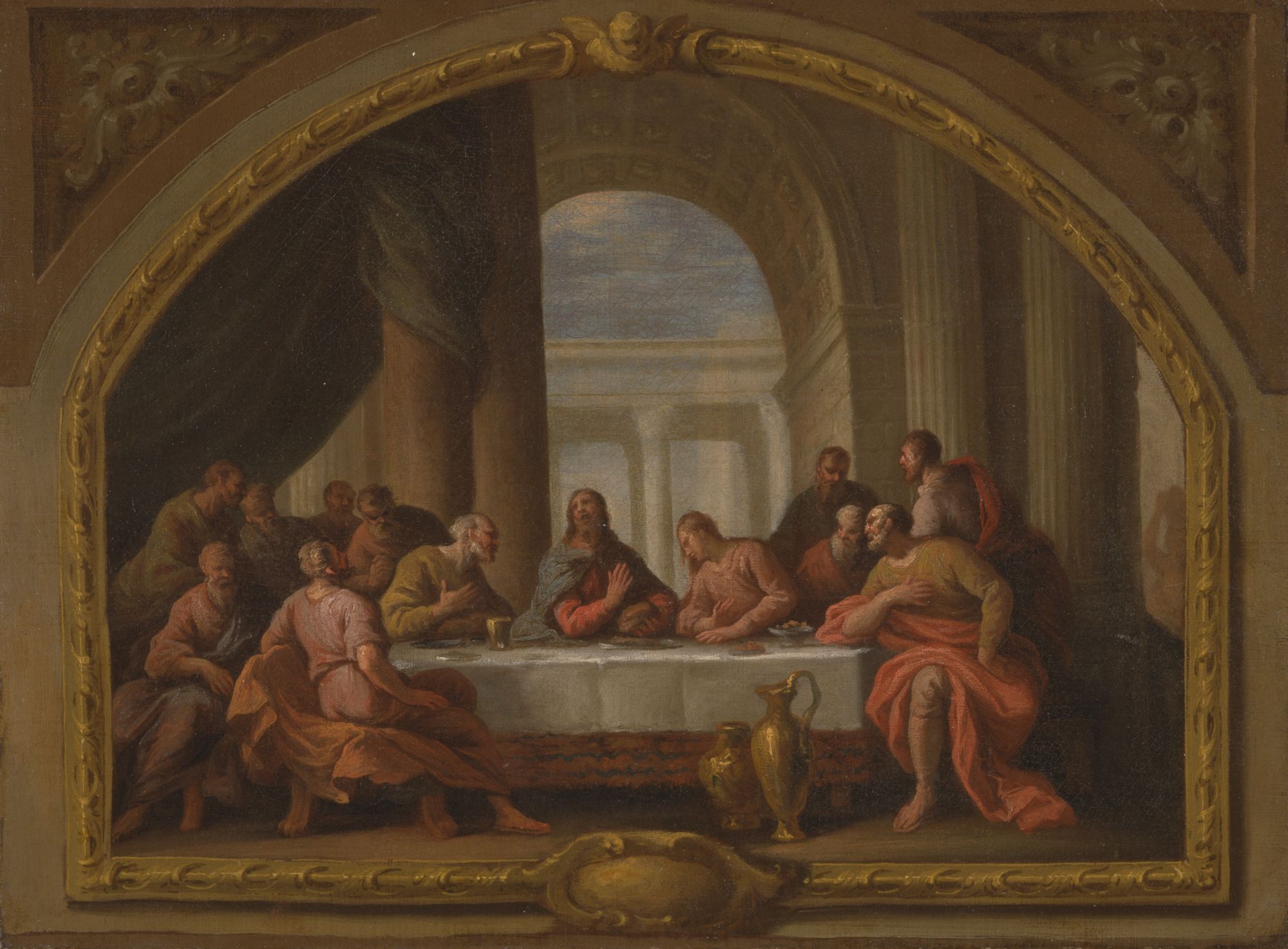
Sir James Thornhillbetween 1719 and 1720Sketch for 'The Last Supper,' St. Mary's, WeymouthYale Center for British Art, Paul Mellon Collection. PDM-1.0Confirmed: the object's own title names the scene and the matched notation or heading is specific to it.
The passage
2 verses26And whilst they were at supper, Jesus took bread, and blessed, and broke: and gave to his disciples, and said: Take ye, and eat. This is my body.
27And taking the chalice, he gave thanks, and gave to them, saying: Drink ye all of this.
In the stacks
Not yet checked6Suggested by an AI model from books the library holds but has not yet set as editions. A passage here is a place to read, not a citation.
Sacred and legendary art, volume 1 (of 2)
In the best and largest composition, the apostles are reclining on couches round the table. Christ holds a plate full of bread, and appears as saying, ‘Take, eat.’ Four are putting the morsel into their mouths. Judas is seen behind, with an abject look, stealing out of the room. * * * * * The faults which I have observed in pictures of this subject are chiefly met with in the Venetian, Flemish, and later Bolognese schools. When the _motif_ selected is the institution of the Eucharist, it is a
0.73Sacred and legendary art, volume 1 (of 2)
To the right of Christ are Peter, Andrew, Bartholomew; to the left, James Minor. Four turn their backs, and two young apostles stand on each side,—I presume Thomas and Philip; they seem to be waiting on the rest: Judas dips his hand in the dish. I suppose the moment to be the same as in the composition of Duccio. But in the next compartment the _motif_ is different. All have risen. from table; it is no longer a repast, it is a sacred mystery; Christ is in the act of
0.69The Golden Bough
For the same reason Catholics partake of the Eucharist fasting; and among the pastoral Masai of Eastern Africa the young warriors, who live on meat and milk exclusively, are obliged to eat nothing but milk for so many days and then nothing but meat for so many more, and before they pass from the one food to the other they must make sure that none of the old food remains in their stomachs; this they do by swallowing a very powerful purgative and emetic. In some of the festivals which
0.68Sacred and legendary art, volume 1 (of 2)
Sometimes he is omitted altogether; sometimes he is stealing out at the door. In the composition of Luca Signorelli, which I saw at Cortona, all the twelve apostles are kneeling; Christ is distributing the wafer; and Judas, turning away with a malignant look, puts _his_ wafer into his satchel. In the composition of Palmezzano, in the Duomo at Forlì, our Saviour stands, holding a plate, and is in the act of presenting the wafer to Peter, who kneels: St. John stands by the side of Christ, holding the cup: Judas
0.68The Golden Bough
In this he may have been mistaken. If Adonis was indeed, as I have argued, the spirit of the corn, a more suitable name for his dwelling-place could hardly be found than Bethlehem, "the House of Bread," and he may well have been worshipped there at his House of Bread long ages before the birth of Him who said, "I am the bread of life." Even on the hypothesis that Adonis followed rather than preceded Christ at Bethlehem, the choice of his sad figure to divert the allegiance of Christians
0.68Psychological Types
1 Cf. Jung, Collected Papers: Content of the Psychoses, Idem, Psychology of Unconscious Processes. 2 Logos appearing in human form as Christ the Son of God. 84 PROBLEM OF TYPES IN HISTORY 5. The Holy Communion Controversy between Luther and Zwingli Of the later antagonisms which stirred men’s minds Protestantism and the Reformation movement should really receive our first consideration. Only this phenomenon is of such complexity that it must first be resolved into many separate psychological processes before it can become an object for analytical elucidation. But that lies
0.67
How this subject was made
The subject was opened by an Iconclass notation. The library's map reads 73D244, whose own gloss is institution of the Eucharist, i.e. Christ showing or blessing bread (host) and/or wine (Matthew 26:26-27; Mark 14:22-23; Luke 22:19-20; John 13:26; 1 Corinthians 11:23-25)
, as Matthew 26:26-27; a picture reaches this page when the notation a cataloguer put on it resolves here, whether the cataloguer wrote the notation down or wrote a subject heading that carries one. The authority is iconclass.org/73D244.
Connections
Painted
- Sketch for 'The Last Supper,' St. Mary's, Weymouth1719Confirmed: the object's own title names the scene and the matched notation or heading is specific to it.