A subject
Pilate showing Christ to the people, 'Ostentatio Christi', 'Ecce Homo'
John 19:4-615301 hand
Opened by a notation lookup, not by an editor. Iconclass 73D36 glosses this subject as “Pilate showing Christ to the people, 'Ostentatio Christi', 'Ecce Homo' (John 19:4-6)”, and this library reads the Douay-Rheims, where the passage stands at John 19:4-6.
Pilate therefore went forth again, and saith to them: Behold, I bring him forth unto you,…
John 19:4
An editor has read one picture against this passage and confirmed it.
The hands
1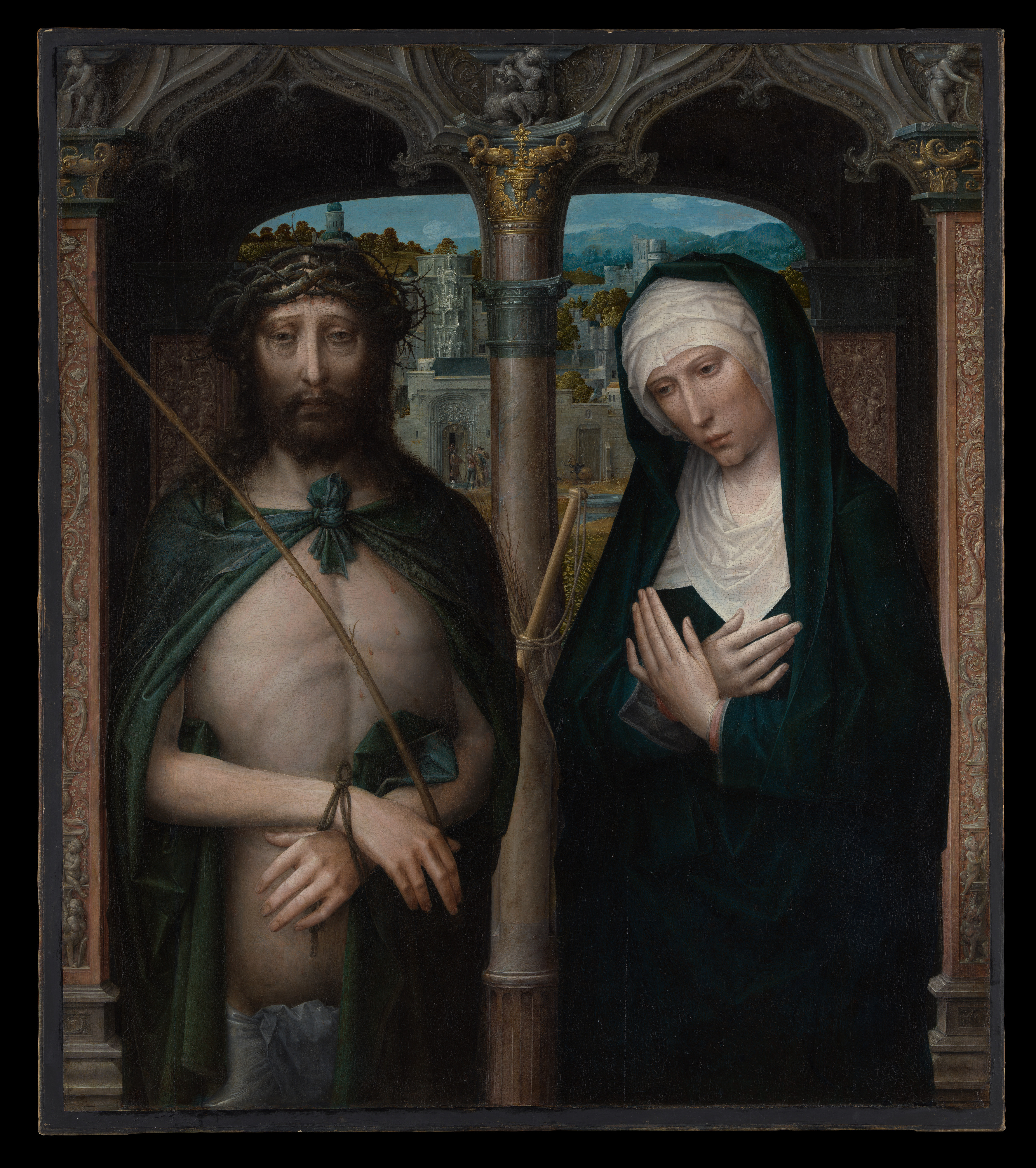
Adriaen Isenbrantca. 1530–40Christ Crowned with Thorns (Ecce Homo), and the Mourning Virgin (Mater Dolorosa)Rogers Fund, 1904. CC0-1.0Confirmed: the object's own title names the scene and the matched notation or heading is specific to it.
The passage
3 verses4Pilate therefore went forth again, and saith to them: Behold, I bring him forth unto you, that you may know that I find no cause in him.
5(Jesus therefore came forth, bearing the crown of thorns and the purple garment.) And he saith to them: Behold the Man.
6When the chief priests, therefore, and the servants, had seen him, they cried out, saying: Crucify him, crucify him. Pilate saith to them: Take him you, and crucify him: for I find no cause in him.
In the stacks
Not yet checked6Suggested by an AI model from books the library holds but has not yet set as editions. A passage here is a place to read, not a citation.
Christian iconography
During the thirteenth and fourteenth centui Temark me first appearance and frequent adoptio; iconographic theme, which will be noticed at length chapter on the Tnnity. God is at this period fre represented sitting in heaven and holding in hia ai Son affixed to the cross. Thus the crucified is not o upon earth, where he expired, in the midst of agoni( distorted hia glorious body, but Ma cruel anguish brought to sadden heaven. Thenceforth, the crt instrument of his suffering, will rarely be found even when the Saviour ia shown
0.69Below the suffering and the needy, above the powerful and helpful--mutually dependent, mutually illustrative.” It will be seen at once what an immense complex of feelings interpenetrating and mutually affecting one another such a work sets up in the mind of a Christian spectator, and all this merely by the content of the picture, its subject, the dramatic story it tells. Now if our Christian spectator has also a knowledge of human nature he will be struck by the fact that these figures, especially in the lower group, are all
0.69The Stones of Venice, Volume 2 (of 3)
HOSANNA IN THE HIGHEST: BLESSED IS HE THAT COMETH IN THE NAME OF THE LORD." And observe in this writing that the convert is required to regard the outpouring of the Holy Spirit especially as a work of _sanctification_. It is the _holiness_ of God manifested in the giving of His Spirit to sanctify those who had become His children, which the four angels celebrate in their ceaseless praise; and it is on account of this holiness that the heaven and earth are said to be full of His glory.
0.68Sacred and legendary art, volume 1 (of 2)
An example at hand is the bronze bas-relief on the tomb of Henry VII.[134] Madonna pictures, in which the two St. Johns stand before her throne, occur frequently. I remember, also, a marble group of the Virgin and Child, in which the two St. Johns, as infants, are playing at her feet, one with his eagle, the other with his reed cross.[135] As one who bore the most direct testimony to the Incarnation, St. John is often introduced into Madonna pictures, and pictures of the Nativity; but in the later
0.68The Philosophy of Fine Art, volume 1 (of 4)
Abel knows his lesson as a pious and good boy ought to. Cain on the contrary behaves and replies to his teachers as only naughty and wicked boys would think of doing; and when it is his turn to repeat the commandments turns them inside out: thou shalt steal, thou shalt not honour thy father and mother, and so forth. A representation of much the same crude simplicity having for its subject the tale of our Lord's Passion used to be carried out in South Germany, was then made illegal,
0.68The Works of Aurelius Augustine, a New Translation, Vol. IX- On Christian Doctrine, the Enchiridon
Cuap. xxxvi.—fhe grace of God is clearly and remarkably displayed in raising : the man Christ Jesus to the dignity of the Son of God. Now here the grace of God is displayed with the greatest’ power and clearness. For what merit had the human nature in the man Christ earned, that it should in this unparalleled ‘way be taken up into the unity of the person of the only Son of God? What goodness of will, what goodness of desire and intention, what good works, had gone before, which
0.68
How this subject was made
The subject was opened by an Iconclass notation. The library's map reads 73D36, whose own gloss is Pilate showing Christ to the people, 'Ostentatio Christi', 'Ecce Homo' (John 19:4-6)
, as John 19:4-6; a picture reaches this page when the notation a cataloguer put on it resolves here, whether the cataloguer wrote the notation down or wrote a subject heading that carries one. The authority is iconclass.org/73D36.
Connections
Painted
- Christ Crowned with Thorns (Ecce Homo), and the Mourning Virgin (Mater Dolorosa)1530Confirmed: the object's own title names the scene and the matched notation or heading is specific to it.