A subject
Expulsion of Adam and Eve from paradise
Genesis 3:22-241445–14952 hands
Opened by a notation lookup, not by an editor. Iconclass 71A6 glosses this subject as “expulsion of Adam and Eve from paradise (Genesis 3:22-24)”, and this library reads the Douay-Rheims, where the passage stands at Genesis 3:22-24.
And he said: Behold Adam is become as one of us, knowing good and evil: now,…
Genesis 3:22
An editor has read 2 pictures against this passage and confirmed them.
2 hands, 1445 to 1495
The hands
2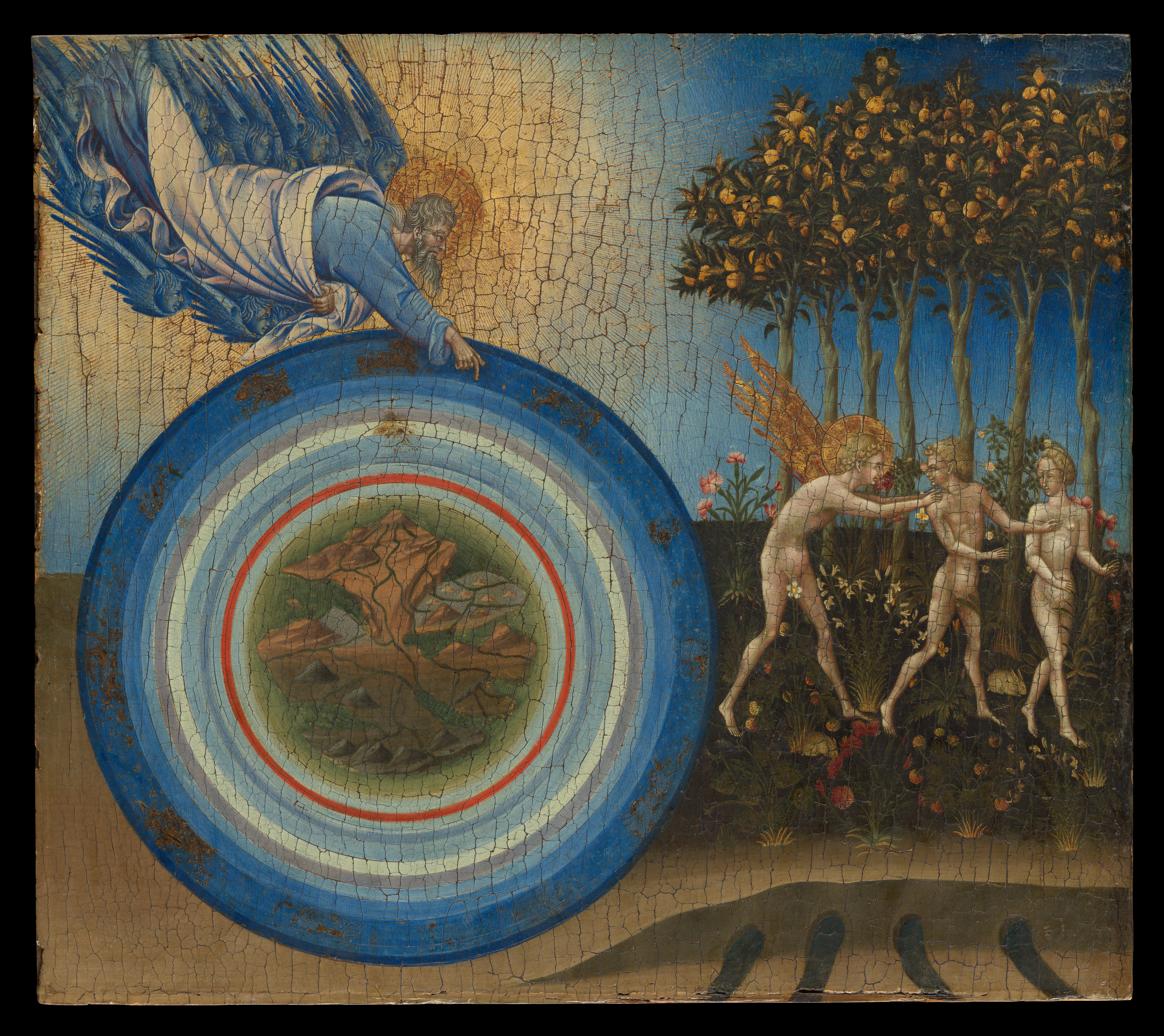
Giovanni di Paolo (Giovanni di Paolo di Grazia)1445The Creation of the World and the Expulsion from ParadiseRobert Lehman Collection, 1975. CC0-1.0Confirmed: the object's own title names the scene and the matched notation or heading is specific to it. 
Workshop of Hieronymus Boschc. 1500–c. 1520The Garden of ParadiseRobert A. Waller Memorial Fund. CC0.. CC0-1.0The same panel again, with the angel and the gate at its edge. Three subjects for one picture is right here: a garden panel of this kind is built to be read as a sequence.
The passage
3 verses22And he said: Behold Adam is become as one of us, knowing good and evil: now, therefore, lest perhaps he put forth his hand, and take also of the tree of life, and eat, and live for ever.
23And the Lord God sent him out of the paradise of pleasure, to till the earth from which he was taken.
24And he cast out Adam; and placed before the paradise of pleasure Cherubims, and a flaming sword, turning every way, to keep the way of the tree of life.
In the stacks
Not yet checked6Suggested by an AI model from books the library holds but has not yet set as editions. A passage here is a place to read, not a citation.
Christian iconography
• The subjoined note is extracted from Curzon's " Monasteries of the Levant," a most interesting work : — ** It is related in the apocryphal Gospel of Nicodemus, that when Adam fisH sick, he sent his son Seth to ^e gate of the terrestrial Paradise to ask theaagel for some drops of the oil of mercy, which distilled from the Tree of Life, to cure him of his disease; but the angel answered that he could not receive tbs healing oil until 5500 years had passed away. He gave
0.76(79) The first doctrine we find in the history of the first man, where it is narrated that God commanded Adam not to eat of the fruit of the tree of the knowledge of good and evil; this seems to mean that God commanded Adam to do and to seek after righteousness because it was good, not because the contrary was evil: that is, to seek the good for its own sake, not from fear of evil. (80) We have seen that he who acts rightly from the true knowledge
0.76(58) Hence the affirmations and the negations of God always involve necessity or truth; so that, for example, if God said to Adam that He did not wish him to eat of the tree of knowledge of good and evil, it would have involved a contradiction that Adam should have been able to eat of it, and would therefore have been impossible that he should have so eaten, for the Divine command would have involved an eternal necessity and truth. (59) But since Scripture nevertheless narrates that God did give
0.76Christian iconography
* On earth, i^hither thou goest to descend^ Thou mlt have enough travail and suffering. To free Adam from prison, And deliver him from punishment. And more than thirty years journey Shalt thou make and pilgrimage Before the season shall arrive. To work out his redemption. For if a very perfect man Thou art not, when doing the deed Of redeeming him, complaint Will be made by offended justice. And because for a long time Thou wilt make pilgdmage, ' A staff and scrip tbcm needest. For which at Uttst
0.74The Works of Aurelius Augustine, a New Translation, Vol. IX- On Christian Doctrine, the Enchiridon
CuAr. xXv.—Cod’s judgments upon fablen men and angels. The death of the body is man’s peculiar punishment. And yet such a nature, in the midst of all its evils, could not lose the craving after happiness. . Now the evils I have mentioned are common to all who for their wickedness have been justly condemned by God, whether they be men or angels. But there is one form of punishment peculiar to man—the death of the body. God had threatened him with this punish- ment of death if he should
0.74Problems of mysticism and its symbolism
p. 311 ff-) ANALYTIC INTERPRETATION 75 The Adam myth also contains the motive of the separated primal parents. In Genesis we do not, of course, see the myth in its pure form. It must first be rehabilitated. Stucken accomplishes this in re- garding Adam and Eve (Hawwa) as the original world-parent pair, and Jahwe Elohim as the sepa- rating son god. By a comparison of Adam and Noah he incidentally arrives by analogical reason- ing at an emasculation of Adam. In connection with the " motive of the sleeping primal
0.74
How this subject was made
The subject was opened by an Iconclass notation. The library's map reads 71A6, whose own gloss is expulsion of Adam and Eve from paradise (Genesis 3:22-24)
, as Genesis 3:22-24; a picture reaches this page when the notation a cataloguer put on it resolves here, whether the cataloguer wrote the notation down or wrote a subject heading that carries one. The authority is iconclass.org/71A6.
Connections
Painted
- The Creation of the World and the Expulsion from Paradise1445Confirmed: the object's own title names the scene and the matched notation or heading is specific to it.
- The Garden of Paradise1495The same panel again, with the angel and the gate at its edge. Three subjects for one picture is right here: a garden panel of this kind is built to be read as a sequence.