In-class exercise
Shape building
Build three pictures in Illustrator using only twelve given shapes. Move them, turn them, copy them, cut them. Never resize them, never draw.
- Time
- In class. Hand in before you leave.
- Tools
- Illustrator. Shape Builder, Pathfinder, Align. No pen tool.
Get the files
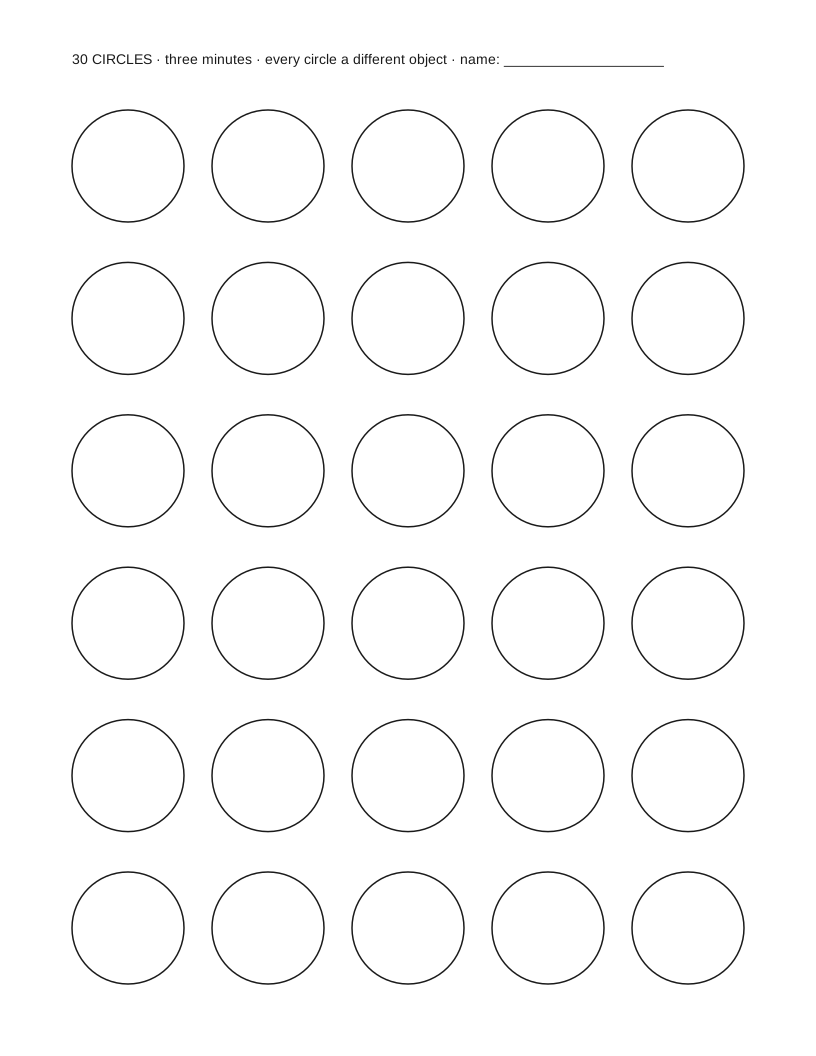
For the warm-up: Thirty circles
For shape building
Four artboards, the twelve shapes already on each. Open it and start.
File > Open.
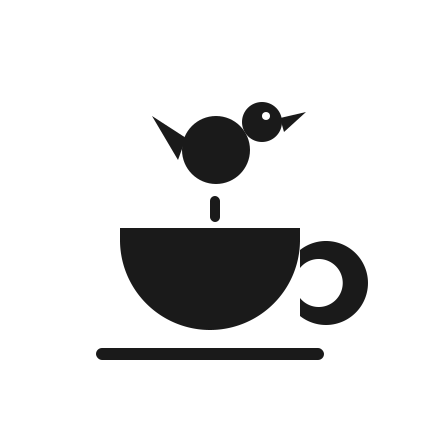
A coffee cup whose steam is a bird. Made from the kit only.
Opens in Illustrator. File > Open, or File > Place.
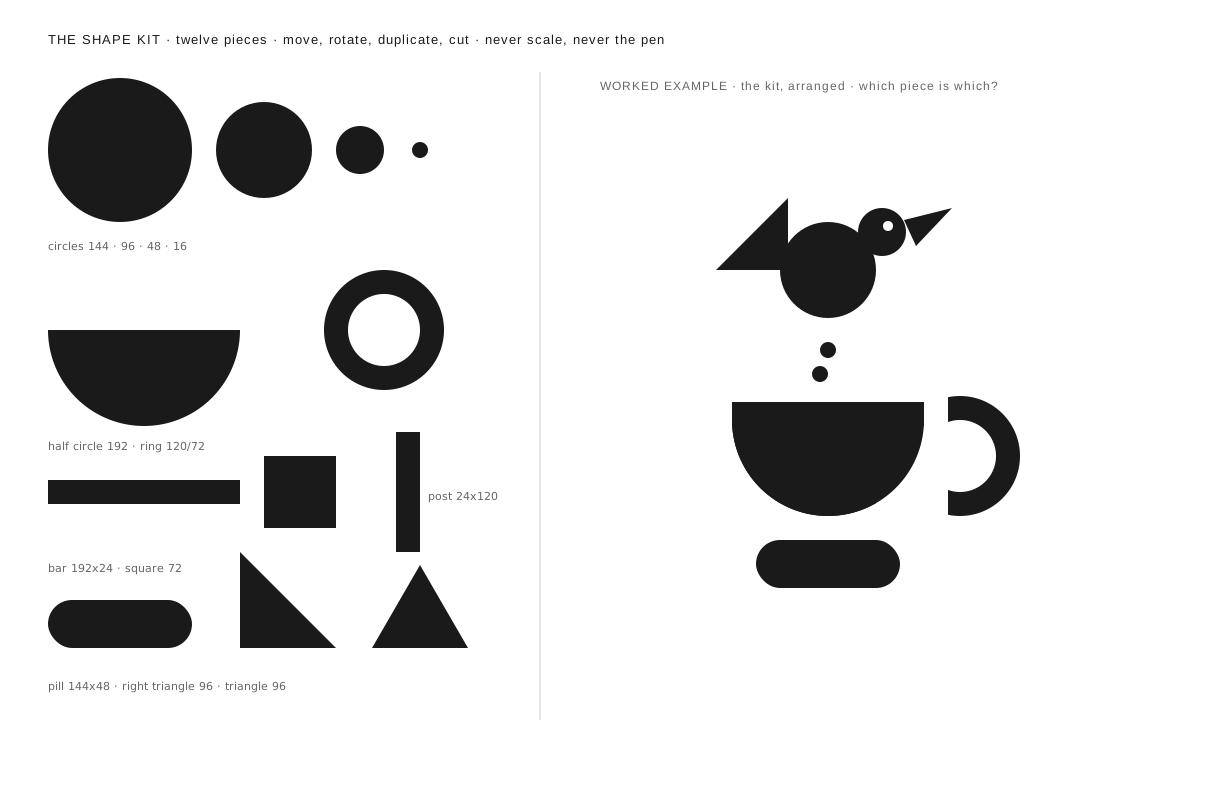
The twelve shapes with the example beside them, for reference.
Opens in Illustrator. File > Open, or File > Place.
First Thirty circles
Ten minutes, with the talk after.
Thirty empty circles, three minutes. Turn each one into a different thing.
How it goes
You get the sheet as you sit down. Three minutes on the clock. Make every circle something: a clock, a pizza, a face, a wheel, a planet. Most people get ten or fifteen and stall. Keep going. Change category, or let two circles make one thing.
Then two minutes around the room. What did you draw that nobody else did? What got you moving again when you stalled?
Why
One shape, thirty meanings. The meaning comes from what you add, not from the circle. That is the whole idea of today, tried on paper before the software gets involved.
Hand in
Photograph the sheet and upload it with the exercise.
Then Shape building
In class. Hand in before you leave.
Set up
Open the starter file. It has four artboards, Sketch 01, 02, 03, and
Composition, and the twelve shapes are already sitting on each one.
Save it as lastname-shapes.ai and start.
The one rule
Everything you make comes from the twelve shapes in the kit.
You can: move, rotate, copy, and cut pieces with Shape Builder or Pathfinder.
You cannot: resize a piece, draw with the pen, or drag an anchor point.
If a piece does not fit, do not shrink it. Arrange it differently.
What to make
Sketch 01, 02, 03: three pictures. Three different things, one per artboard. A fish, a house, a face, a lamp, whatever you like. Each one should be recognizable when you zoom out to the size of a postage stamp.
The cup-bird on the kit sheet is the example. Pull it apart first if you want to see how it was done.
Composition. Pick one of your three and go one step past it. Either:
- Say a word without a subject. Arrange kit pieces so the board reads as one word: calm, tension, crowded, growth. No object, just the feeling.
- Hide a second picture. One silhouette that is two things at once. The second thing lives in the holes you cut out of the first.
The composition does not need to be finished. It needs to follow the rule.
Hand in
- The .ai file, all four artboards.
- A photo of your thirty circles sheet.
Grade
Same day. 0, 2 or 3. The six exercises share one grade and the lowest is dropped.
- 2: three pictures that read small, every piece from the kit at its original size, no pen, and the pieces are still separate and editable.
- 3: all of that, plus a composition that follows the rule and lands.
- 1: fewer than three, a resized or hand-drawn piece, pictures that need a caption, or everything flattened into one lump.
Artist
Alexander Girard
1907 to 1993
Forty wall panels from circles, bars, and triangles. Eighty suns from one circle. This exercise, done by a master.
Architect, textile designer, and collector. Ran the textile division at Herman Miller for twenty years and built a whole career from a few fixed shapes moved, repeated, and cut: the Herman Miller fabrics, the suns of La Fonda del Sol, the Braniff redesign, the Environmental Enrichment Panels, the wooden dolls. Kept ten thousand folk art objects, now the Girard Wing in Santa Fe.
Look at
Environmental Enrichment Panels1972The Henry Ford; Herman Miller
Forty wall panels for the first office cubicles. Eyes, hearts, hands, suns, all from circles, bars, and triangles. Herman Miller reprinted eight as posters.
La Fonda del Sol1960SFMOMA
One restaurant, more than eighty different suns. Same circle, different rays, on matchbooks, menus, and platters.
Textiles for Herman Miller1952 onwardMaharam still weaves several
Small Triangles, Double Triangles, Quatrefoil, Trispot. Tangent shapes where the only variable is which color lands where.
Wooden Dolls1952 onwardVitra
A post, a ball, and a bar, with a face painted on.
Multiple Visions: A Common Bond1982Museum of International Folk Art, Santa Fe
The ten thousand folk art objects he collected, arranged by him. Where the shapes came from.
Watch later
Alexander Girard: Architect of Modern LivingDress Code, for Herman Miller2019
The five-minute tribute film, made for his AIGA Medal.
Wooden Dolls by Alexander GirardVitra2022
The dolls being turned and hand painted.
Braniff: The End of the Plain PlaneBraniff Airways Foundation1965
The public reveal film. An airline rebuilt from flat color and a few marks.
Alexander Girard's miniature folk art collectionYouTube
A walk through the Girard Wing in Santa Fe.