SESSION 13
10.07.26

Standing Apart
How to get noticed on a crowded shelf.

Workhorse Collective

NameAbraham GarciaEmailabe@wrkhrs.co

ART 418 · Fall 2026

MeetsMon + WedTodaySession 13 · 10.07.2026
Workhorse wrkhrs.co
The rest of the term

What is due, from today to the last class.

Wed Oct 14Milestone 2: your pitch, updated, with at least three moodboards
Wed Nov 4Milestone 3: the brand, presented
Wed Dec 2Milestone 4: the brand book and the landing page, presented
TodayThe moodboards checkpoint
Wed Oct 28The rules, written for a machine
Mon Nov 16The brand book, drafted
Mon Dec 7, last classMilestone 4, day two. Final versions of everything, and the personal statement
Mon Oct 19The direction and the first rules
Mon Nov 2The system, reviewed
Mon Nov 23The landing page, first build
Mon Oct 12No class, fall break
Wed Nov 25No class, Thanksgiving
Milestones are presented to the room. Checkpoints are the smaller steps on the way to each one.

Today.

Part
What
You leave with
0
Pin up. Your boards go on the wall, and the PDF goes on Blackboard under "Checkpoint: Moodboards," due at 1:30.
The moodboards checkpoint, turned in
1
Same and different. What happens to a product when it looks like all the others.
The word "commodity," and three ways out of it
2
How brands got here. From a mark burned into a cow to a brand people join.
Why brands compete on meaning now
3
Three brands that went the other way. Volkswagen, Avis, and Pepsi.
What breaking a convention looks like
4
Find yours. Map what every brand in your category does, then pick one thing to break.
A map of your category
5
A case from now. Packages that dress like a different product, and where that goes too far.
A test for your own idea
6
Saying it. How to tell a client why your brand looks different.
Three sentences for each path
7
Work time. Desk visits on every board.
Boards ready for the Oct 14 presentations
STANDING APART · WED 10.07 · MOODBOARDS CHECKPOINT DUE 1:30 TODAY · MILESTONE 2 OCT 14 Workhorse

Next week you present your project again, updated with what you have learned since the pitch.Today's lesson gives you one more way to talk about your boards: what makes your brand stand apart from the others on the shelf.

The pitchYour first presentation, recorded Sept 21.
The briefWho the brand is for and what it should make them feel. Turned in Sept 30.
The boardsAt least three moodboards, added to the deck and presented on Oct 14.
Part 1

Same and differentWhat happens to a product when it looks like all the others.

When every choice looks the same, people buy the cheapest one.Picture the sugar aisle. If you believe every bag of sugar is the same, the only thing left to compare is the price. A product in that spot is called a commodity.

There are three common ways out. Each one gives the shopper a reason to choose that is not the price.

The packageA bag or a box that people notice and remember from across the aisle.
The storyA history worth telling, like the brand your grandmother always bought.
How it is madeOrganic, local, fair trade, or grown in a way that matters to the person buying it.
THE SUGAR AISLE AND THE THREE WAYS OUT ARE FROM DAVIS, CH. 1, "DIFFERENTIATION," READ AUG 26 Workhorse

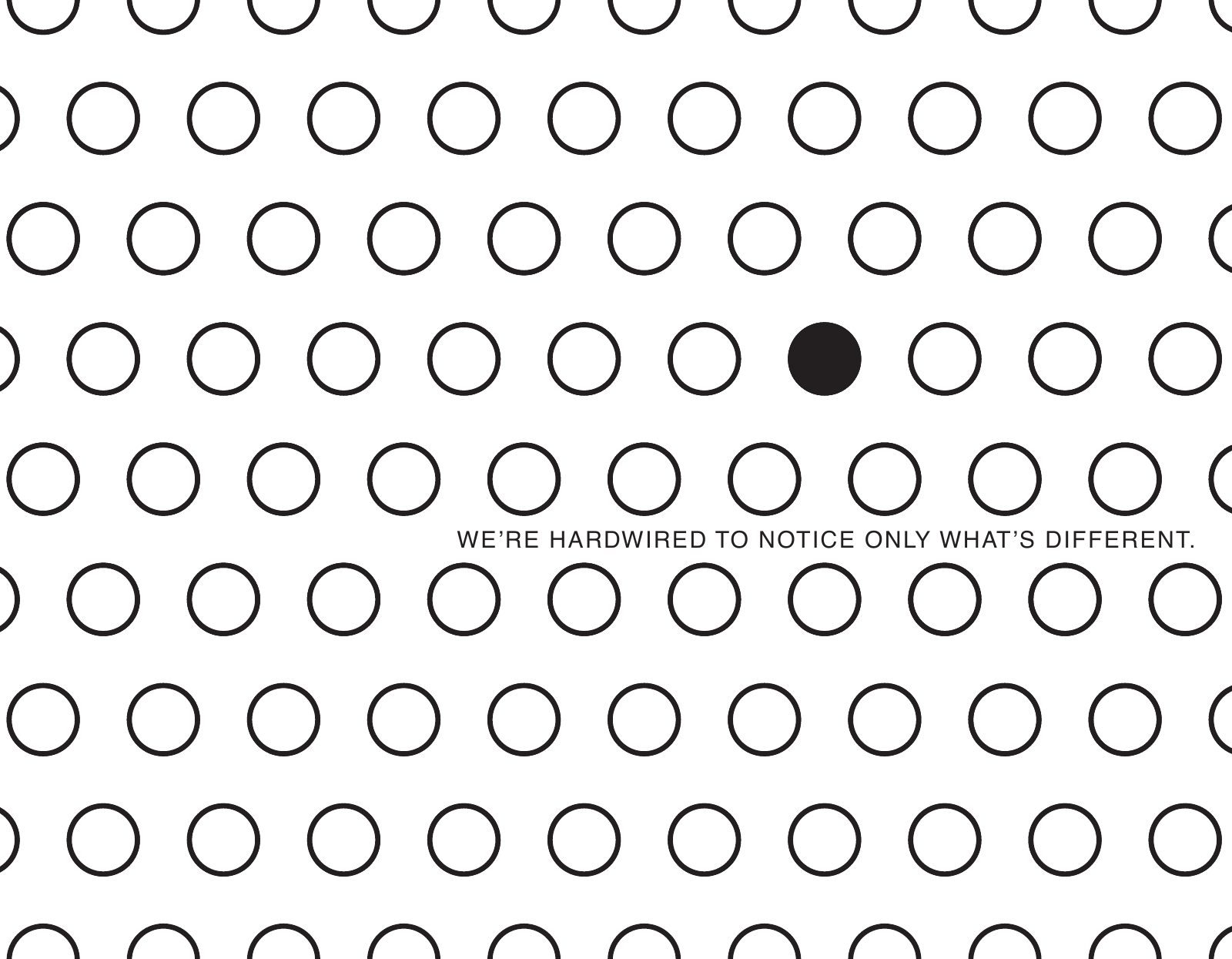
People only notice what is different.

A grid of open circles with one filled in
"Our brains act as filters to protect us from too much information. We're hardwired to notice only what's different."
The Brand Gap, Discipline 1 · read Sept 30

Your eyes and brain throw away most of what they see, because there is too much of it. What gets through is whatever does not match the things around it.

That means a brand that looks like the rest of its category is not just less interesting. Most people will not see it at all.

A brand has to look like it belongs in its aisle, and still give people one reason to pick it.

A supermarket in Seattle, 1955 · Seattle Municipal Archives, CC BY 2.0

Points of parity, and a point of difference.Davis gives the two halves these names, and you met both in Session 9. Here they are on one product.
Points of parity
Point of difference
What it means
What every brand in the category has to have, or people will not trust it
The one thing that is yours alone, and the reason to pick you over the one next to you
Dove soap, 1957
It cleans, it is a white bar, and it sits on the soap shelf at an ordinary price
It is one-quarter cleansing cream, so it does not dry out your skin the way ordinary soap can
If it is missing
People wonder what is wrong with it
People buy whichever bar is cheapest
PARITY AND DIFFERENCE: DAVIS, CH. 6, SESSION 9 · THE POSITIONING STATEMENT IS IN YOUR BRIEF Workhorse
Part 2

How brands got hereFrom a mark burned into a cow to a brand people join.

Word history
brandOld English · a word that started as fire
Where it came from
Proto-Indo-European*bʰrewh₁-to boil, to brew
→
Proto-Germanic*brinnanąto burn
→
Proto-Germanic*brandazflame, firebrand, torch, sword
→
Old Englishbrandfire, flame, a burning stick, a torch, a sword
→
English · nowbranda name and a mark that stand for a product, and the reputation behind them
How the meaning moved
FirstA piece of burning wood, a torchfirst sense
ThenThe mark a hot iron leaves, on cattle or on a barrel to show what is insideby association
ThenA mark of disgrace burned into a personworsened
ThenA name and a logo that tell people who made a productbroadened
Now"The public image or reputation and recognized, typical style of an individual or group"broadened
Same rootburnbrandyfrom Dutch brandewijn, "burnt wine," wine boiled down
Wiktionary, "brand," etymology and senses, CC BY-SA · Wikipedia, "Brand," history
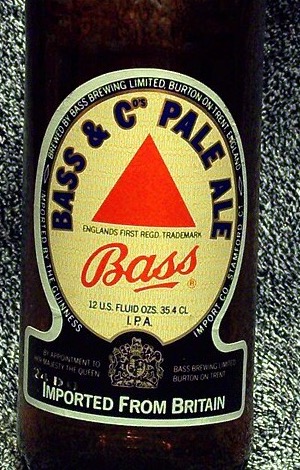
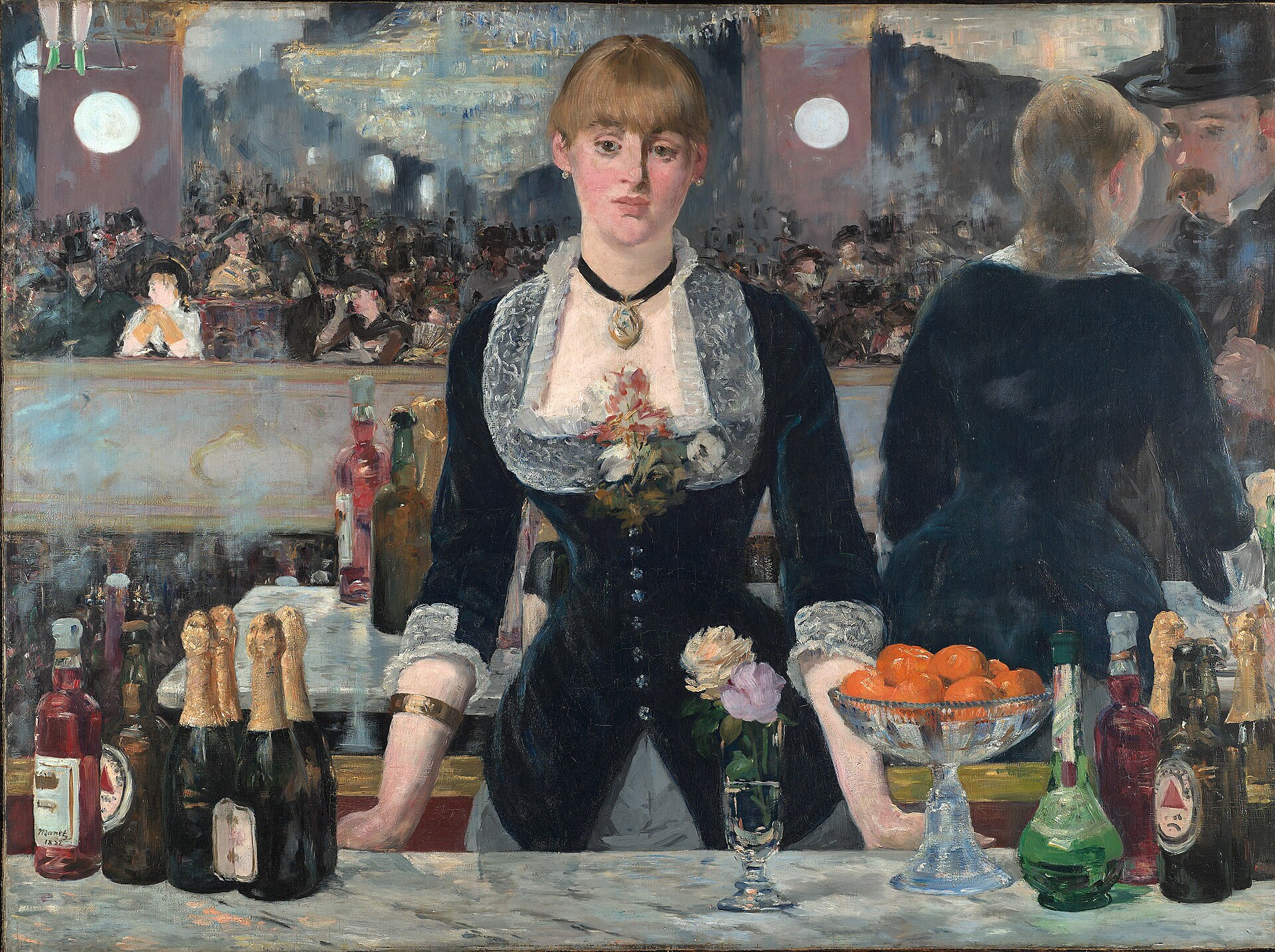
A Bass Pale Ale label: a red triangle above the words England's first regd. trademarkManet, A Bar at the Folies-Bergère, with Bass bottles on the bar
Top: a modern Bass label, which still reads "England's first regd. trademark." Photo by KlipschFan, CC BY-SA 2.0. Bottom: Édouard Manet, A Bar at the Folies-Bergère, 1882. The same red triangle is on the bottles at both ends of the bar.
1876 · The mark becomes property

A mark becomes something a company can own and defend.

"The Bass Red Triangle was the first trade mark to be registered under the UK's Trade Marks Registration Act 1875."
The act came into effect on January 1, 1876
Why it matters
Once the law protects a mark, nobody else can sell their beer with your triangle. The difference now belongs to you.
Six years later
The triangle was famous enough that Manet painted it into one of the best-known pictures of the century.

What a brand promises has moved from what the product is to who you are.
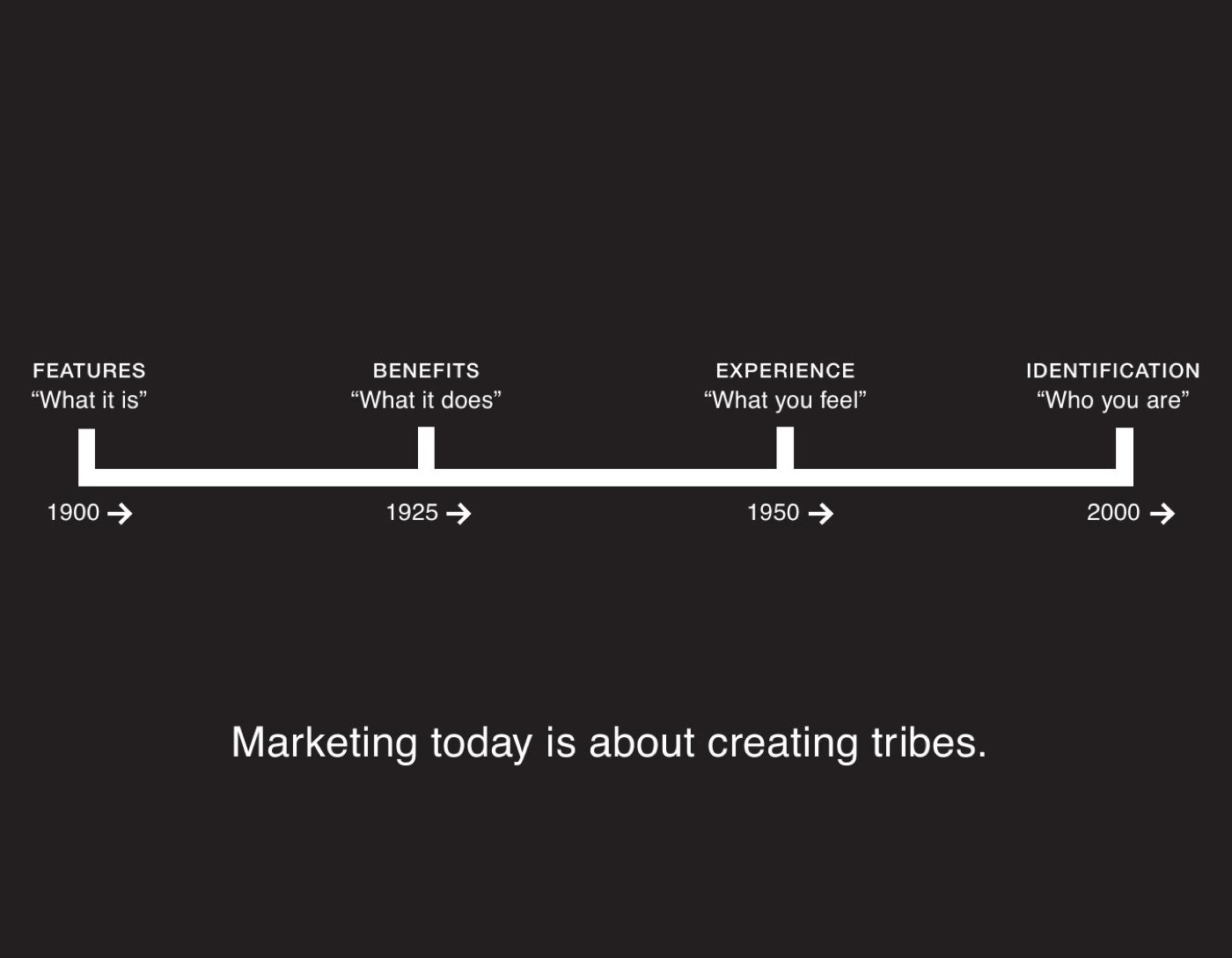
Timeline: features, what it is, 1900; benefits, what it does, 1925; experience, what you feel, 1950; identification, who you are, 2000

Features describe what the product is: steel, four doors, 30 miles a gallon.

Benefits describe what it does for you: it gets you to work.

Experience describes how it feels to use: the drive is fun.

Identification says what owning it says about you: you are a Jeep person.

Each step became a new place to be different, because the step before it had gotten crowded.

It moved because a better product gets copied.If your only difference is a feature, a competitor can add the same feature next year. A meaning is much harder to copy.

"...even if a corporation was successful in creating a legitimate product-based point of difference, it was quickly imitated and duplicated by competitors."
Mark and Pearson, The Hero and the Outlaw, ch. 1 · read Sept 28

They point to the writer Paul Hawken, who argued in 1983 that what a product means had started to matter more than what it is made of. Soon after, companies began paying huge sums to buy other companies just to get their brands, even when the products were nearly the same as everyone else's.

In the 1950s the answer was one claim that no one else could make.The ad man Rosser Reeves called it the unique selling proposition. Each ad makes one specific promise, the competition cannot or does not make it, and it is strong enough to pull in new customers.

M&M's"Melts in your mouth, not in your hand." One fact about the candy shell that other chocolate could not claim.
Anacin, 1952"Fast, incredibly fast relief." A painkiller sold on speed alone.
What it missesThe claim is about the product. Once a competitor matches it, the difference is gone.
ROSSER REEVES, REALITY IN ADVERTISING, 1961 Workhorse

Then the question became where your brand sits in people's minds.Two ad men, Al Ries and Jack Trout, argued that people are flooded with ads and keep only what fits an open spot in their heads. They called the work of finding that spot "positioning."

"...the typical consumer is overwhelmed with unwanted advertising and has a natural tendency to discard all information that does not immediately find an empty slot in their mind."
Jack Trout, Industrial Marketing, 1969 · then Ries and Trout, Positioning: The Battle for Your Mind, 1981

The positioning statement in your brief comes from this idea. Davis sends you to Ries and Trout if you want more.

Part 3

Three brands that went the other wayEach one looked at what everyone else was doing, and did one thing the other way on purpose.

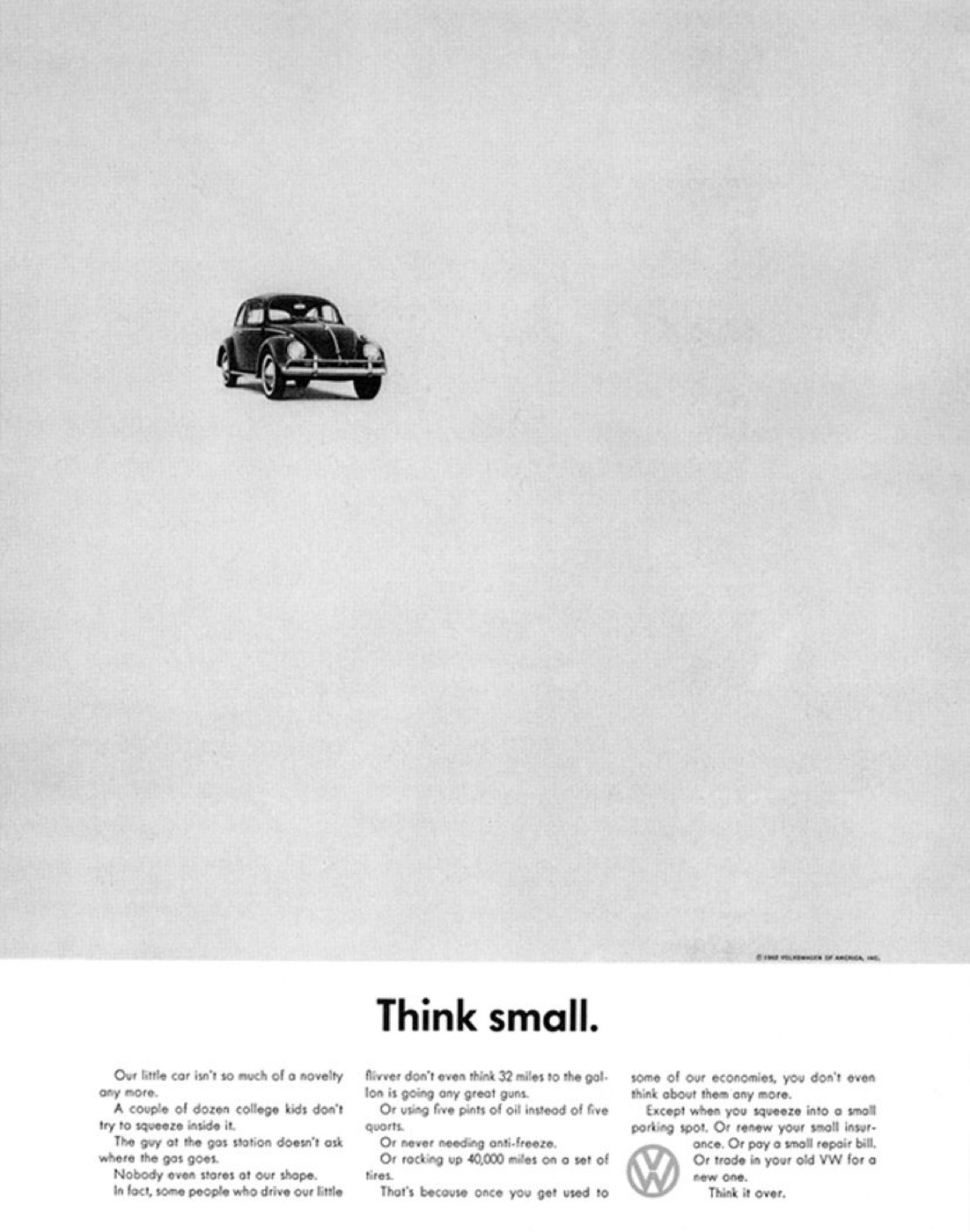
In 1959, Detroit sold bigger cars. Volkswagen sold a small one.
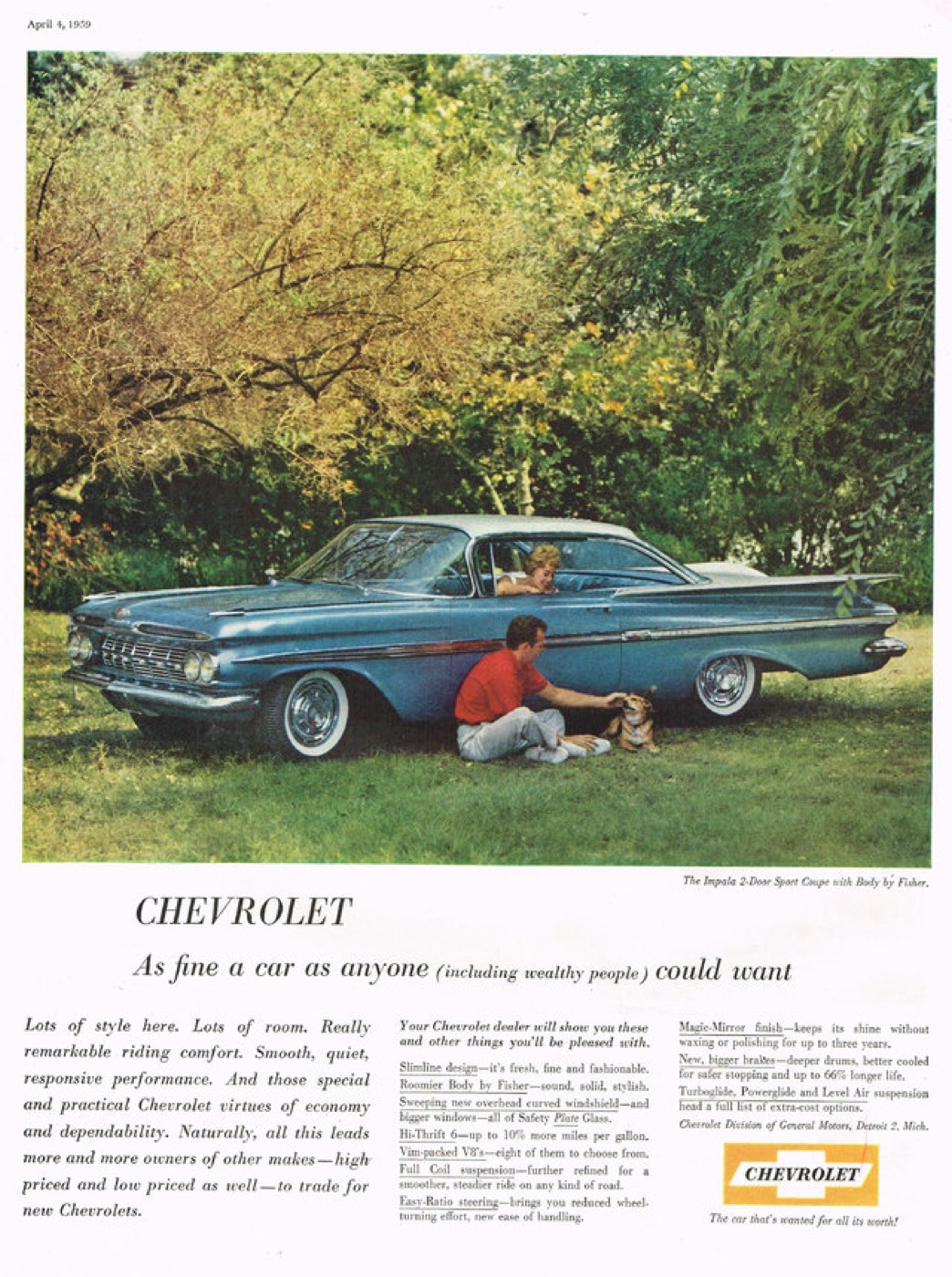
1959 Chevrolet Impala ad: a long car on a lawn, full-color photo
Chevrolet, April 1959. "Lots of style here. Lots of room."
Volkswagen Think Small ad: a tiny Beetle in a field of white
Volkswagen, 1959. "Think small."

Look at what the car ads of the time had in common: color photos, long cars, a happy couple, and a list of everything the car could do.

Volkswagen's ad broke almost every one of those habits. It is black and white, the car is tiny, most of the page is empty, and the writing is plain and a little funny about itself.

The car was different, so the ad was different too.

The small car became a way to say who you were.You read this case on Monday. To young people in the sixties, big American cars were their parents' "living rooms on wheels." The Beetle was the opposite, and they chose it for that.

"Bill Bernbach's brilliant advertising positioned this new 'anticar' in ways that captured its unique spirit. His clever, humorous, award-winning commercials showed the Innocent 'Bug' outwitting big gas-guzzlers: Little David getting the better of big Goliath."
Mark and Pearson, ch. 2 · read Oct 5

The difference started in the product: small, cheap, easy to fix, and the style never changed. The advertising made people feel that difference.

Avis was in second place. It made second place the reason to choose it.
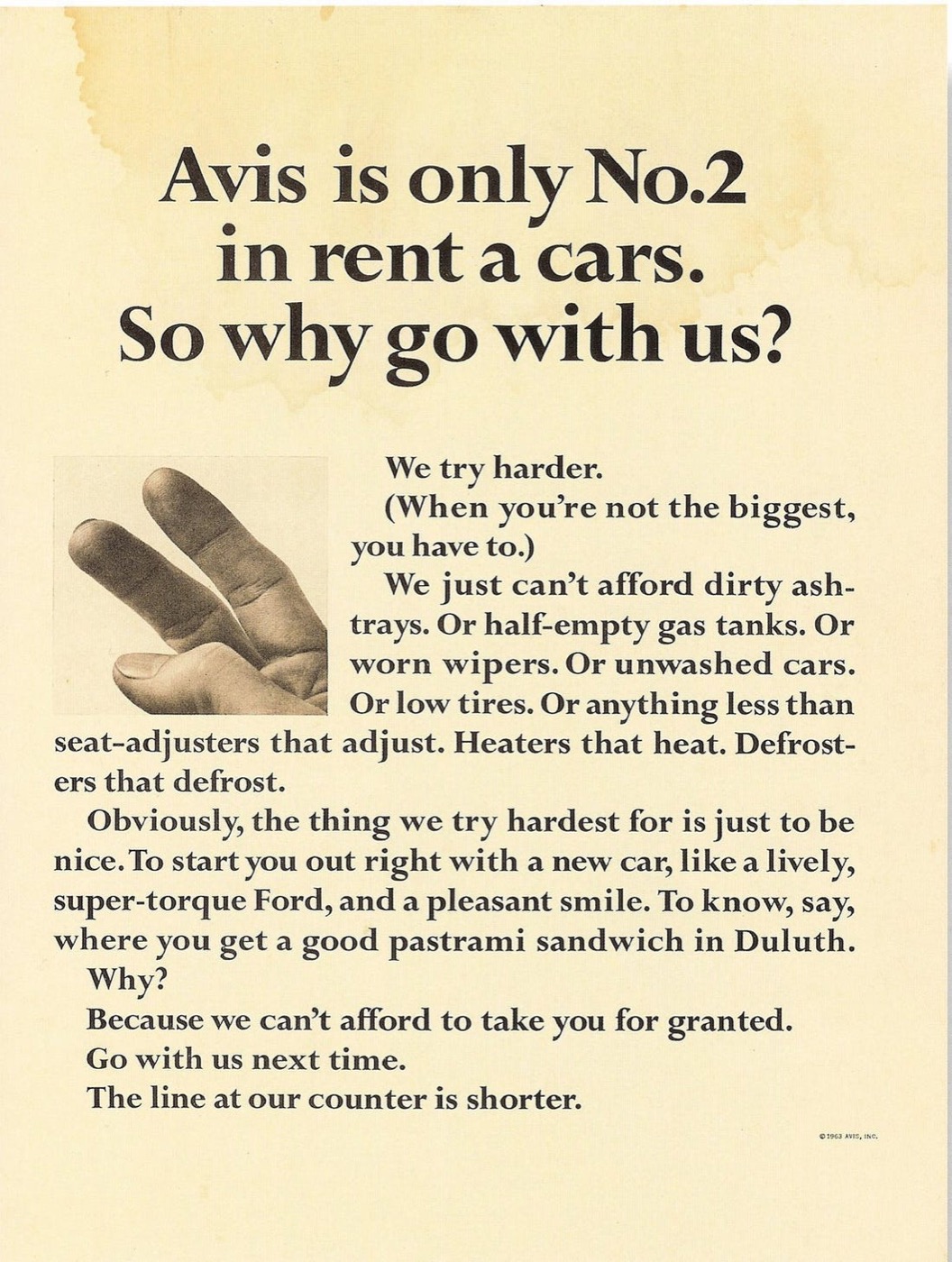
Avis ad: Avis is only No. 2 in rent a cars. So why go with us? We try harder.

Every rental company said it was the biggest or the best. Hertz really was the biggest. Avis was losing money.

In 1962 the copywriter Paula Green, at the same agency that made "Think small," wrote ads that admitted Avis was number two and turned it into a promise:

"Avis is only No. 2 in rent a cars. So why go with us? We try harder. (When you're not the biggest, you have to.)"

Within about a year, Avis went from losing millions to making a profit for the first time in more than a decade.

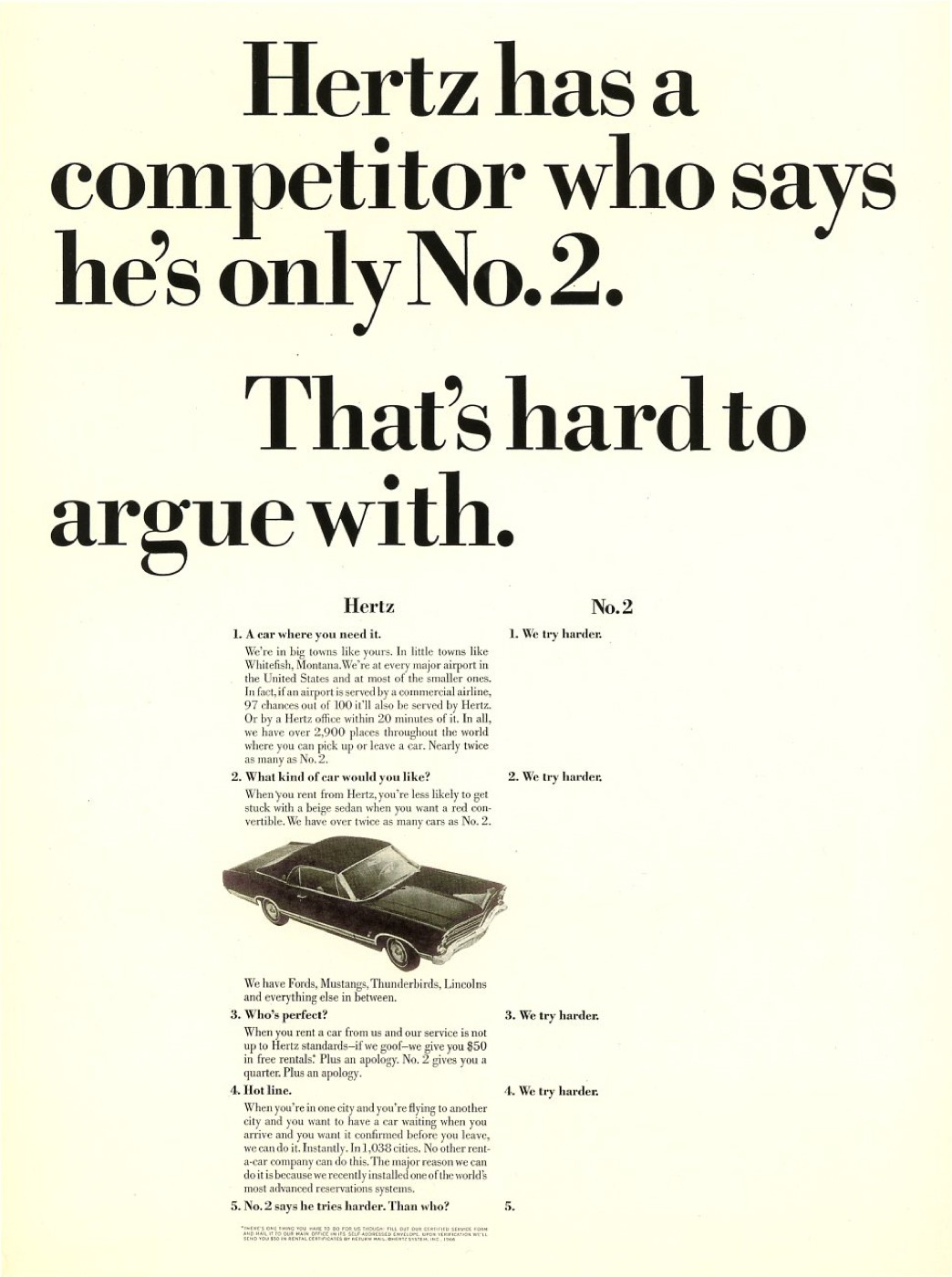
A good difference forces the leader to answer it.
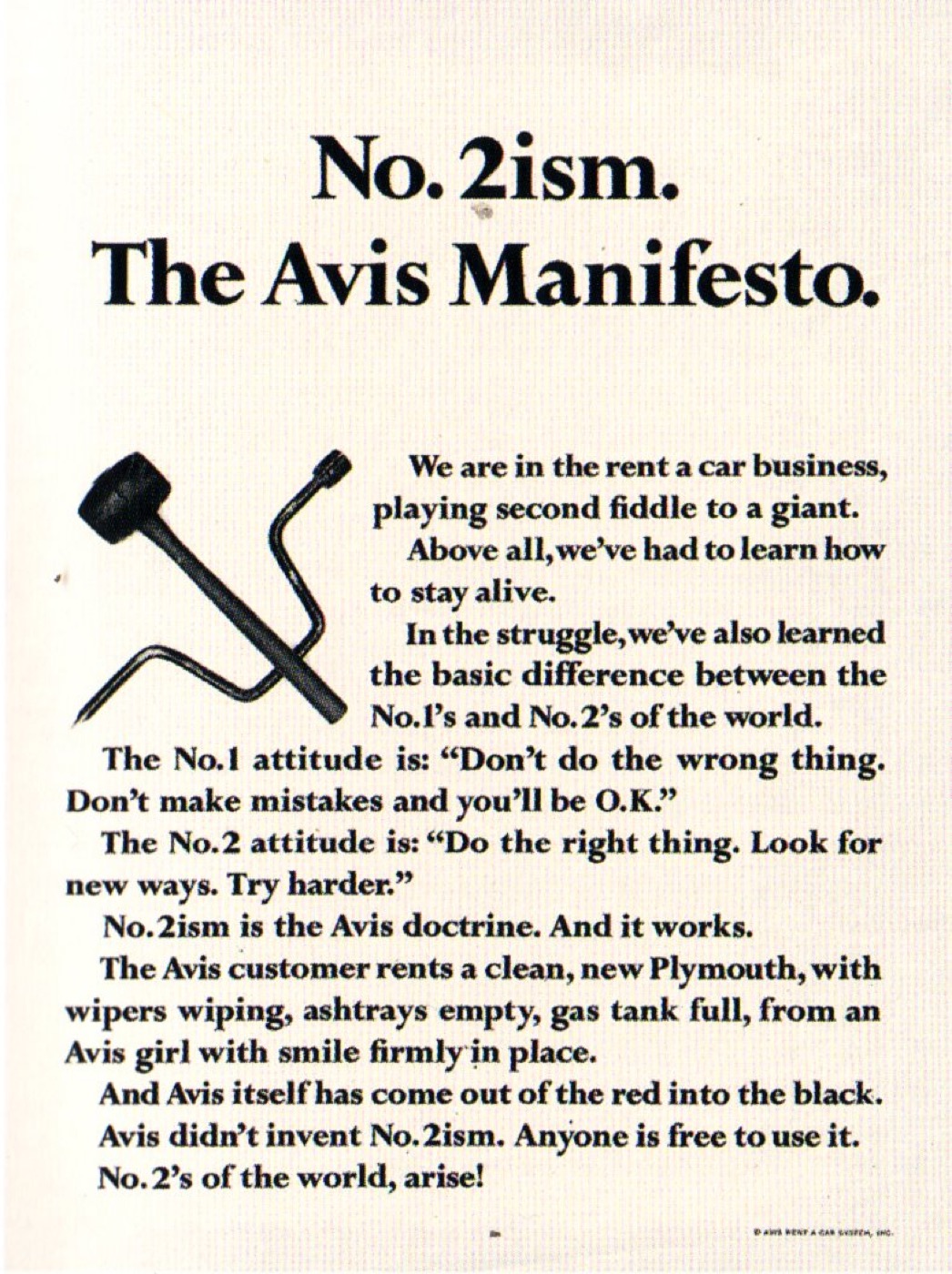
Avis ad: No. 2ism. The Avis Manifesto.
Avis, "No. 2ism. The Avis Manifesto."
Hertz ad: Hertz has a competitor who says he's only No. 2. That's hard to argue with.
Hertz, 1966. "Hertz has a competitor who says he's only No. 2. That's hard to argue with."

For years Hertz said nothing. When Hertz finally answered, it was arguing on Avis's terms.

Avis also kept going. "No. 2ism" turned the idea into a set of beliefs the staff could work by, not only a line in an ad.

That is the test of a real difference: a whole brand can stand on it.

Two colas that taste almost the same mean very different things.From Monday's reading. When the products are close, the meaning carries the difference.

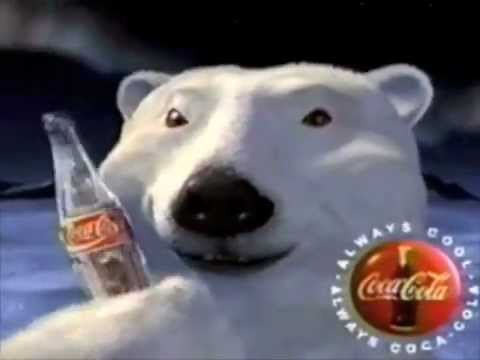
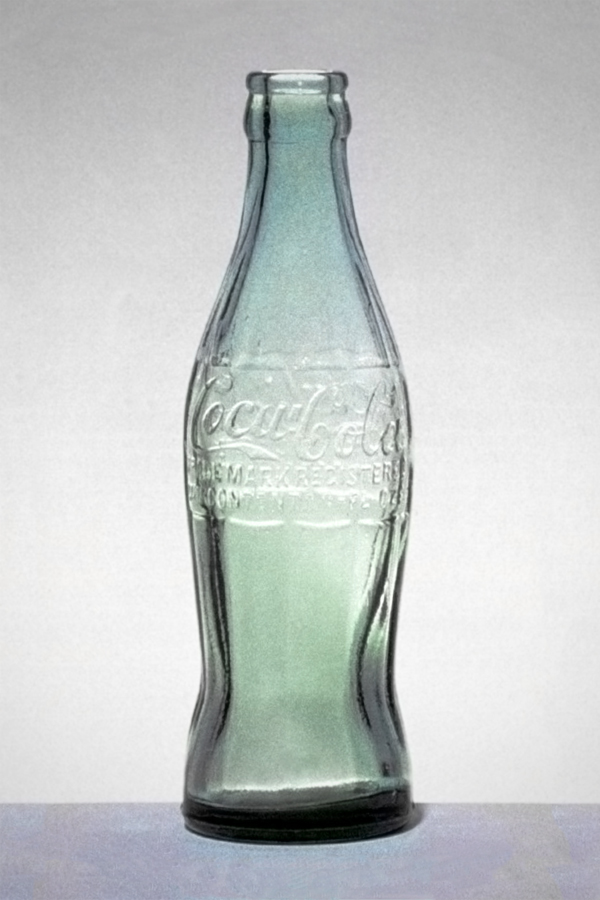
Coca-Cola · the Innocent
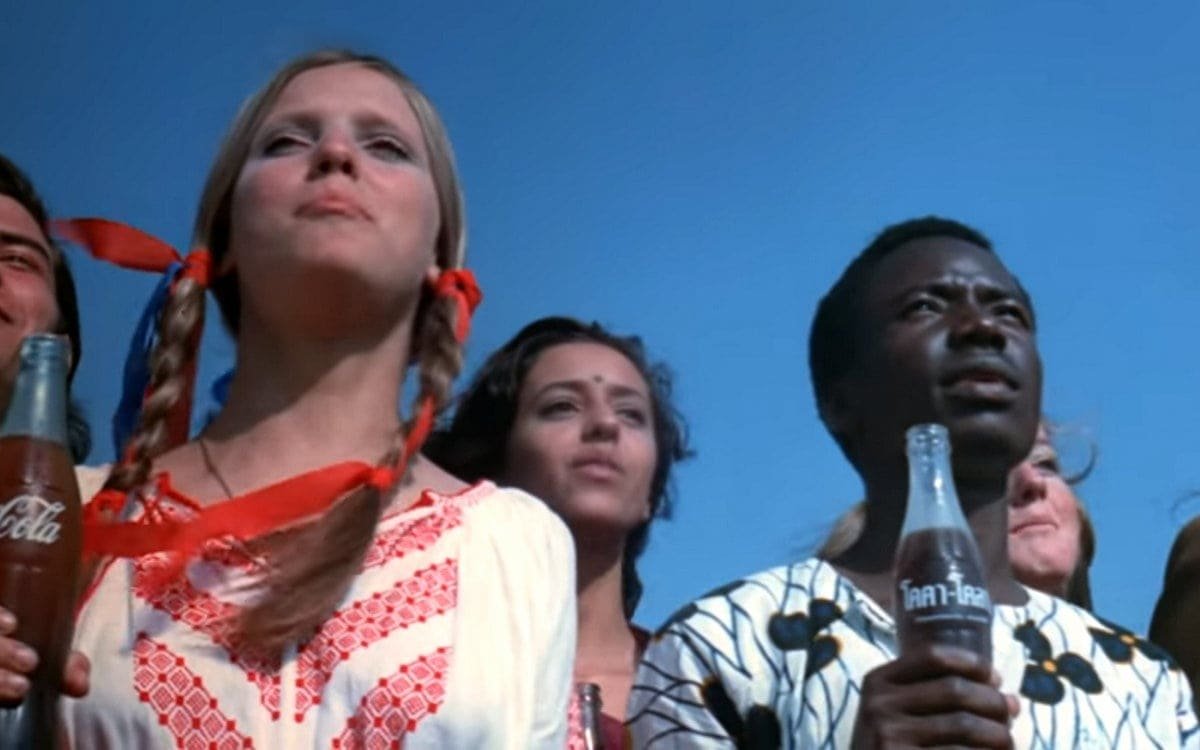
Young people on a hilltop singing and holding Coke bottles
"Hilltop," 1971
An animated polar bear holding a Coke bottle
"Northern Lights," 1993
The 1915 Coca-Cola contour bottle
The bottle, 1915

Polar bears, "I'd Like to Teach the World to Sing," the old bottle.

When Coke changed its formula in 1985, people took it as a betrayal, because the Innocent is supposed to stay the same.

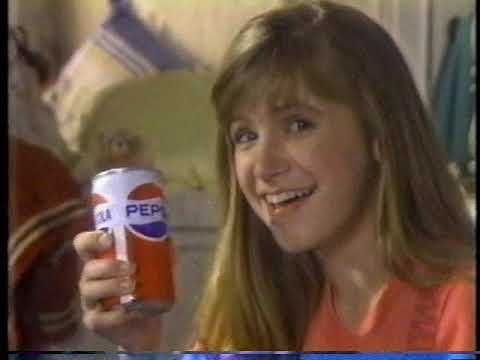
Pepsi · the Jester
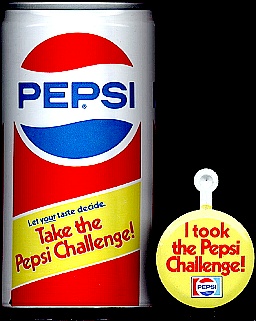
A Pepsi Challenge can and an I took the Pepsi Challenge button
The Pepsi Challenge, from 1975
A teenage girl holding a can of Pepsi
"Why did Coke change?" 1985

The joke, the taste test, the younger crowd.

When Coke changed, Pepsi made fun of it. A teenager asks why Coke changed, tastes her first Pepsi, and says, "Now I know."

Mark and Pearson add one warning. A brand gets its difference from a meaning it keeps for years, not from a look it borrows for one campaign.

Part 4

Find yoursFirst see what every brand in your category does. Then pick one thing to do differently.

Step 1: write down what every brand in your category does.Look at five to eight brands your audience already knows. Also list what your audience uses now instead, even if it is not a brand: a notes app, a spreadsheet, or nothing at all. For each row, write what most of them do.

Row
What to look at
An invented example: student budgeting apps
Color
The colors almost everyone uses
Green, for money
Shape
The package, the screen, the container, the logo
A rounded icon and a dashboard full of charts
Name
What kind of names the category uses
Made-up and cute
Voice
How the brands talk
A cheerful coach: "You've got this!"
Price
Where most of them sit
Free with ads, then a monthly plan
Character
The archetype most of them play
The Caregiver, worried about you
FROM HALL, CH. 6, COMPETITIVE RESEARCH, READ SEPT 9 · THE APP CATEGORY IS INVENTED FOR THIS SLIDE Workhorse

Look for the place where everyone is standing.When every brand in a category plays the same character, that character has stopped telling anyone apart.

Car adsSo many sell toughness that it "likely no longer differentiates among cars."
BanksBank after bank plays the Caregiver, which leaves them with "undifferentiated identities."
Instant coffeeEvery brand played the Caregiver until General Foods International Coffees played the Explorer, and earned much higher profits than the rest.
"Is everyone in the category expressing the same one or two archetypes? Is there an opportunity for a truly new archetype in the category?"
Mark and Pearson, ch. 16, "The Artichoke," which you will read on Nov 9

Names follow the crowd too.A personal finance app launched next to competitors called Geezeo, Buxfer, and Wesabe. It called itself Mint.

"...Geezeo, Buxfer, and Wesabe, which together sound like a group of playful macaques. They might be cute, but do you trust them with your money?"
Erika Hall, Just Enough Research, ch. 6 · read Sept 9

Mint was short and easy to spell. It suggested freshness and the green of American money, and it sounded like something you could trust in a category where trust matters most. Naming starts Oct 26, so start the name row of your map now.

Step 2: change one row of your map, and keep the others.Volkswagen and Avis each changed one thing and left the rest of the category alone. That is why people still understood what they were selling.

Volkswagen, 1959
Avis, 1962
What they changed
The look of the ad: a tiny car, black and white, a mostly empty page
The claim: they admitted they were only number two
What they kept
A real car, sold by dealers, advertised in the same magazines as the Chevy
New cars, rented from a counter, at the same kind of price
Why it was true
The car really was small, cheap, and easy to fix
Avis really was smaller than Hertz, and had to try harder

On your map, circle the one row each path changes. Then write what in your research tells you to change it.

BROWN, CH. 2: "SUCCESSFUL PRODUCTS DON'T REINVENT THE WHEEL... YOUR DESIGN CAN'T OFFER THE EXACT SAME THING." Workhorse
Part 5

A case from nowPackages that dress like a different kind of product.

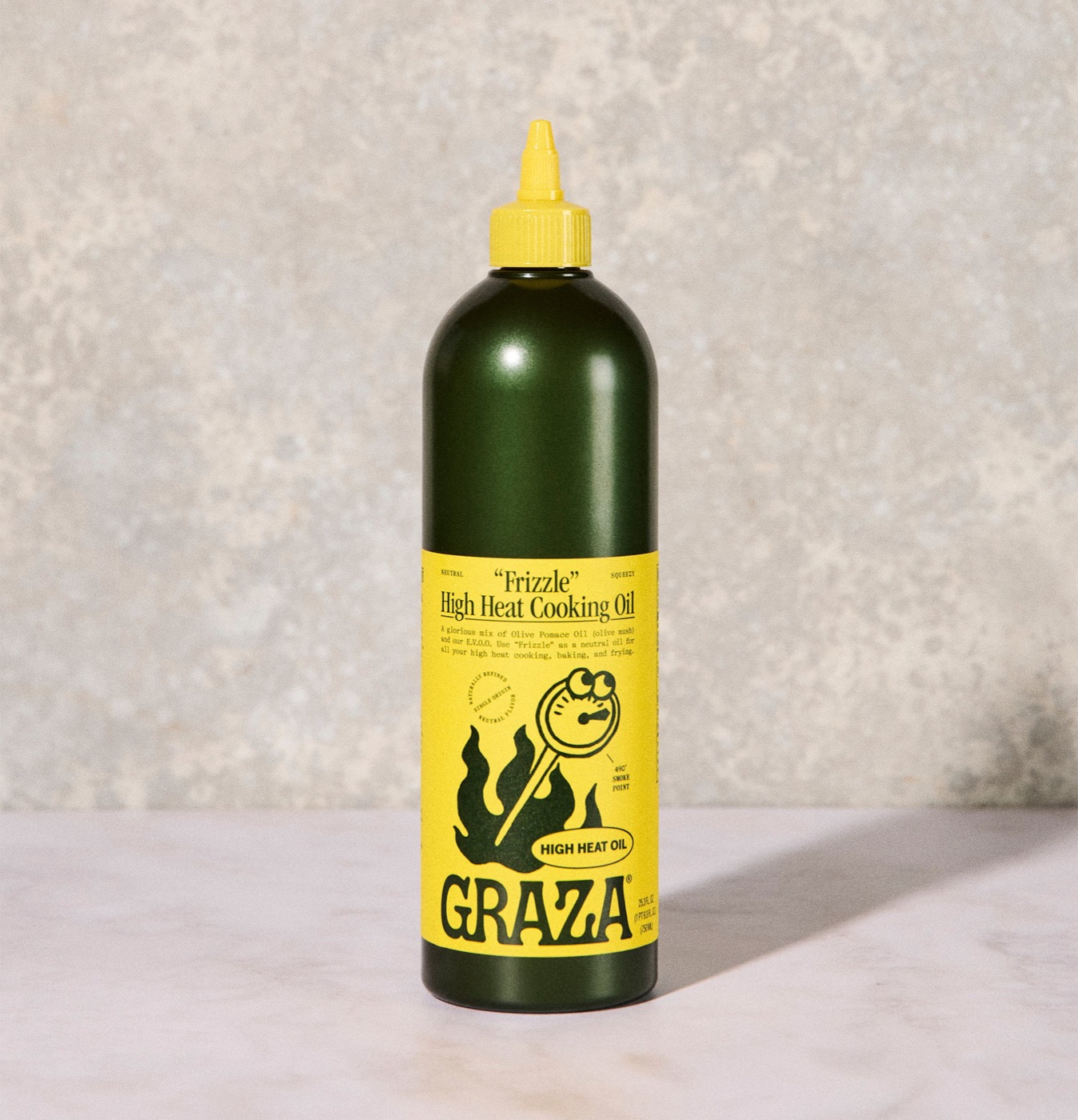
Some brands break the oldest rule in the aisle: what the container looks like.Each one borrows the package of a different product, and the feeling people have about that product comes along with it. Packaging writers call this "chaos packaging."
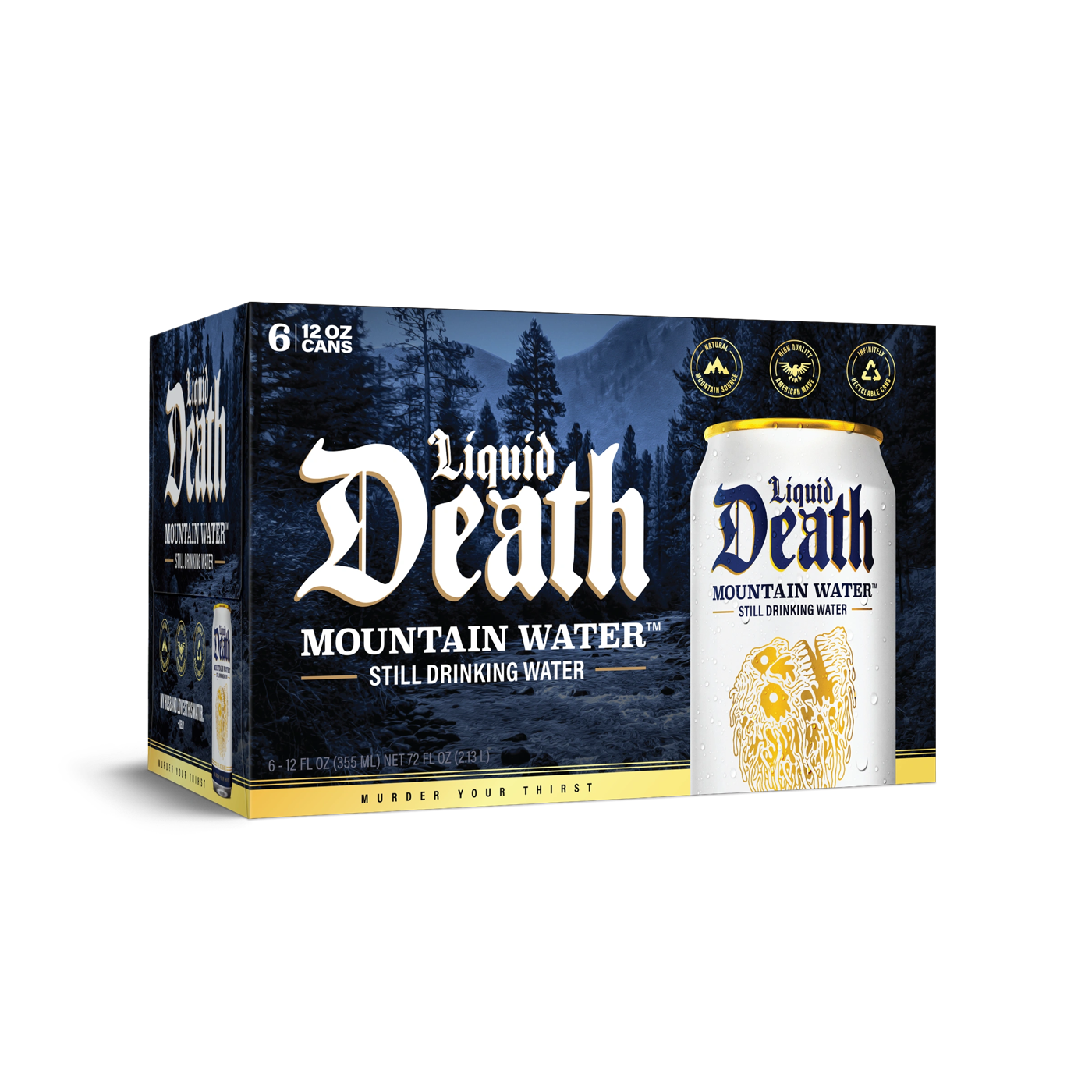
Liquid Death water in tall cans
Liquid Death: water in a tall can with heavy metal lettering, like beer. Water starts to feel like something to order at a show.
Graza olive oil in a squeeze bottle
Graza: olive oil in a diner squeeze bottle. Oil starts to feel like an everyday thing you grab while cooking.
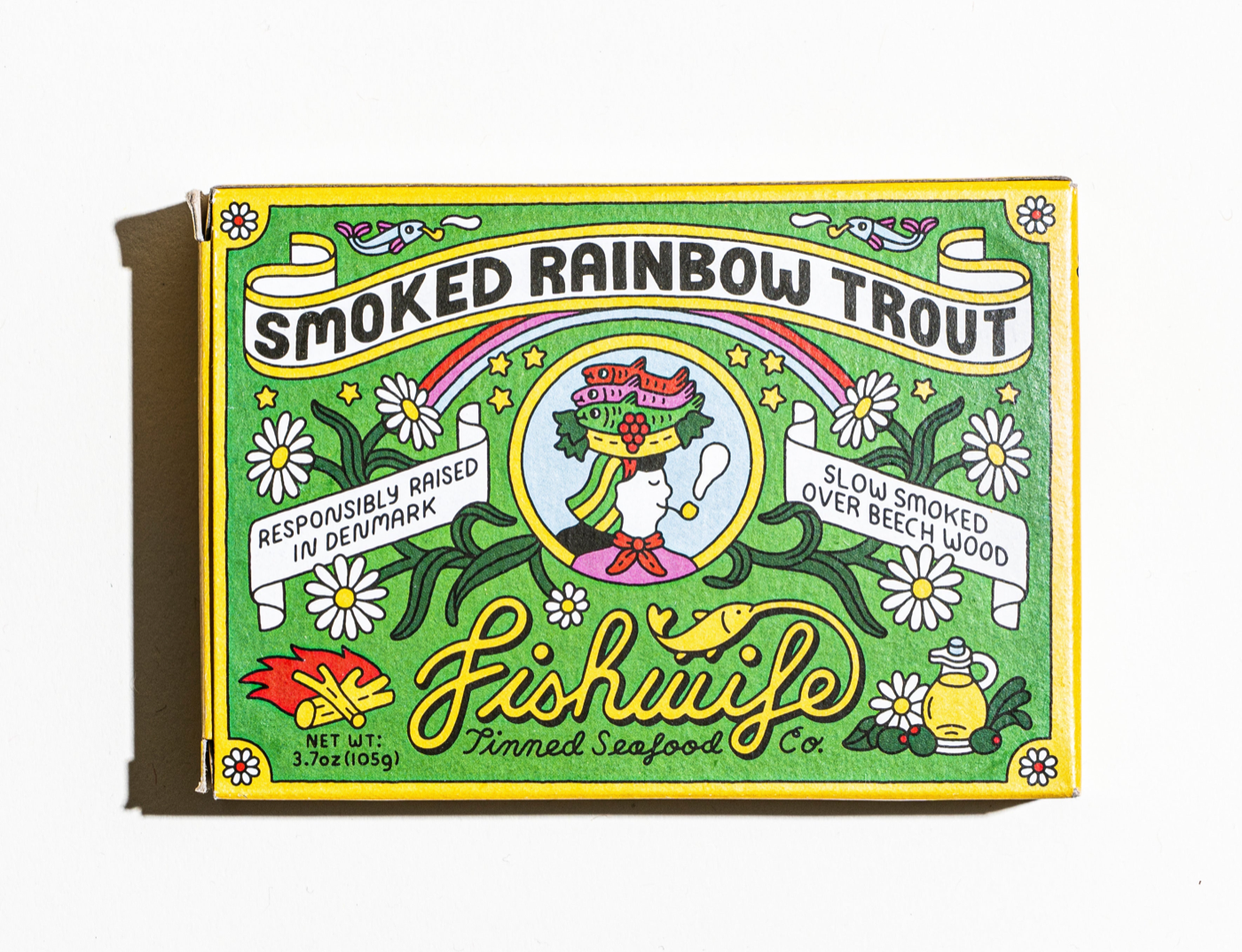
Fishwife illustrated tin
Fishwife: canned fish in tins covered in drawings by Danny Miller. "We turned a historically cheap commodity into a giftable and aspirational object," says co-founder Becca Millstein.
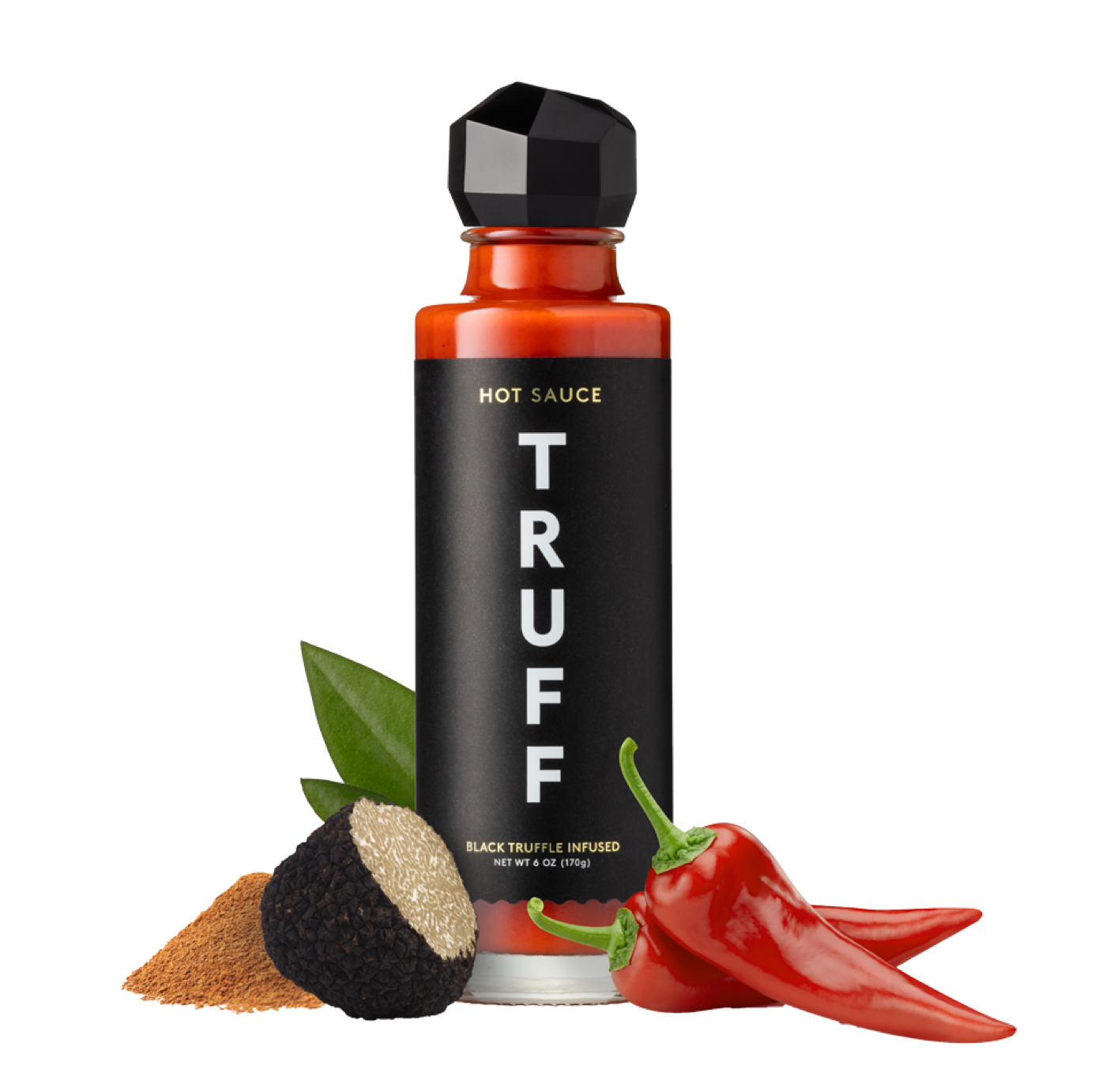
Truff hot sauce in a faceted bottle
Truff: hot sauce in a bottle shaped like cologne. A condiment starts to feel like a gift.

When a difference works, everyone copies it, and it stops being different.

"We tested 300 different squeeze bottles before [settling on] this one, now everyone's look like ours."
Andrew Benin, Graza founder · TASTE, "The Big Squeeze," 2025

This is the copying problem from Part 2, happening to packaging. A squeeze bottle is easy to copy. A meaning the brand keeps for years, in everything it does, is not.

It is also the problem in the article from Monday, "Blame the Moodboard": when everyone looks at the same feeds, everyone ends up making the same thing. Your difference is safer when it comes from your own research, because nobody else has your research.

When a borrowed look fools a child, it is no longer a brand idea.An adult who picks up a can of Liquid Death knows it is water. A child who picks up a bag that looks like Doritos does not know there is THC inside.

THC snacks, 2023

Edibles were packaged to look like Doritos, Cheetos, and Nerds. The FTC and FDA sent the makers letters telling them to stop.

"Marketing edible THC products that can be easily mistaken by children for regular foods is reckless and illegal."

Samuel Levine, FTC Bureau of Consumer Protection · July 5, 2023
Laundry pods, 2012 to 2015

Bright, squishy pods looked like candy, and small children bit into them. The industry wrote a safety standard: packs you cannot see through and that are harder to open.

Ask of every path: could anyone mistake your product for the real thing, and get hurt because of it?

Part 6

Saying itA client who sees a different-looking brand with no setup will argue about taste. Tell them why first.

Tell the client what you noticed before you show the work.Today's reading says to set up the idea before the reveal: what inspired it, and why it fits the business. Then the room argues about the brief, which is the conversation you want.

Sentence
The invented budgeting app, again
What we noticed
Every budgeting app is green and talks like a cheerful coach, and students told us that tone makes them feel judged.
So
An app that wants students to keep opening it should feel calm and plain, so they can open it without dreading it.
The idea
A budgeting app in black and paper white, with no cheering, that talks like a friend who is good with money.
TODAY'S READING · DAVIS, CH. 12, "SELL WITHOUT SELLING": SET THE CONTEXT, THEN INSIGHT, THEREFORE, CONCEPT Workhorse
Part 7 · Work time

Get ready for Oct 14

Work on your moodboards. You need at least three for the presentation.
If it helps, try the map on your own category: a few brands and what most of them do. It is a way to talk about your boards, not something you turn in.
Practice explaining each board to the person next to you in three sentences: what you noticed, so, and the idea.

Before October 14.

What
What to do
Due
The deck
Your pitch deck, updated. Add what you have learned since the pitch and the creative brief, then at least three moodboards, and talk through each one. You present it in class, in three minutes.
Oct 14
Blackboard
Upload the updated deck as a PDF before class
Oct 14, 1:30
NO CLASS OCT 12, FALL BREAK · MILESTONE 2, UPDATED PRESENTATIONS, OCT 14 · MILESTONE 3, THE BRAND, NOV 4 Workhorse
Close

Learn what everyone in your aisle does.
Then change one thing on purpose."When you're only No. 2, you try harder. Or else." Avis, 1960s.