SemesterFall 2026SchoolCharleston Southern University
EVERY NUMBER IN THIS DECK IS INVENTED AND MARKED †. YOURS MAY NOT BE.The pitch
The opening · Who I am
I ran the prep list in someone else’s kitchen for nine years.
Name
Nell Ortiz. Invented for this demonstration, along with everything they are about to tell you.
Work
Nine years cooking on the line. The last four as sous chef, which is the person who runs the kitchen day to day and owns the prep list.
Training
No business school and no design degree. I learned design by building and maintaining the schedule board nobody else would touch.
Where I am now
Out of the kitchen for a year, building the tool I wanted at eleven at night. Two of us, part time, no company yet.
Between ten and midnight, at the end of a fourteen-hour day.
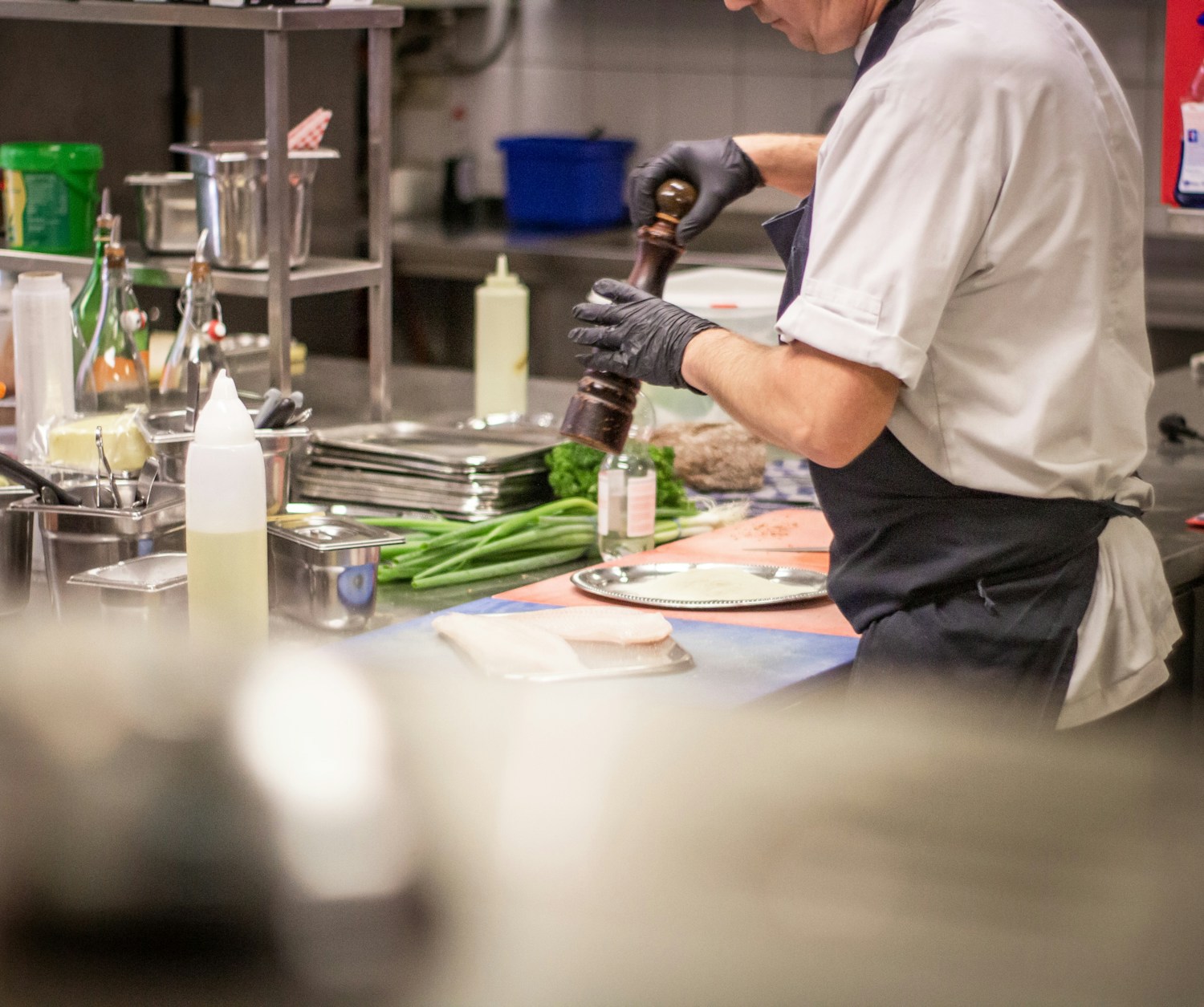
PHOTOGRAPH: PARKER COFFMAN, UNSPLASH · ATMOSPHERE, NOT EVIDENCE
The opening · The problem I have seen
Every kitchen I worked in wrote tomorrow’s list from memory, at midnight, tired.
What the list is
Prep is the day’s cutting, stock and sauces, all done before the restaurant opens. The prep list says what to make tomorrow and how much. Everything the kitchen does hangs off it.
How it gets written
By one tired person standing in the cooler after the last table leaves, counting what is left on the shelves and guessing at what tomorrow will sell.
Why it is a guess
Nothing records what the kitchen actually used during the day. The shelves are the only evidence, and the shelves do not say whether something ran out at seven or sat untouched.
What a wrong guess costs
Guess high and good food goes in the bin. Guess low and a dish runs out halfway through dinner, in front of the guests. Both happen every week.
The opening · The opportunity, and why I am the one
If the record gets made while the work happens, nobody has to remember anything.
The opening
The guessing is not a discipline problem. It is a missing record. Nothing in the kitchen writes down what got used, so the only place to look is the shelves.
Why nobody has taken it
The software sold to restaurants counts what was bought, because that is what the invoices show. What gets used during a shift has never been worth anyone’s trouble to capture.
Why me
I have written this list about twelve hundred times. I know the one thing that decides whether a kitchen tool works: what a cook will actually touch at the end of a shift, which is almost nothing.
What I am not
Not a restaurant technology person and not an engineer. I am bringing the problem and the design. The rest I will have to find or learn.
Section 1 of 5 · Objectives and outcomes
Objectives and outcomes.
Objectives and outcomes · What the product is
In one line
Mise builds tomorrow’s prep list out of what the kitchen actually did today, so nobody has to remember it at midnight.
Not stock-counting software. Not an add-on to the till. One list, made while the shift happens, printed before anyone goes home.
While they cook
A cook taps a tile when a pan goes out or a container is emptied. Two taps, gloves on, no typing. What you get: a record of the day made during the day, instead of pieced together after it.
At the end of the night
The list is already written. The sous chef corrects it instead of writing it. What you get: eight minutes at the end of a shift instead of forty.
The printed list
Every list prints, and the printed sheet is what the kitchen works from. What you get: something that survives a wet hand, a dead battery, and a walk-in cooler with no phone signal in it.
For the owner
What got thrown away, item by item, week by week. What you get: the first real number anybody in that building has ever had about waste.
INVENTED PRODUCT. NOTHING HERE IS BUILT.
Objectives and outcomes · The number under it
One number carries the problem. Every other figure in the deck is a consequence of it.
61%†plan tomorrow from memory
Of independent kitchens, with no written record of the day behind them. Invented for this demonstration. A real version of this slide names the survey, its year, how many kitchens answered and the exact wording of the question, because “from memory” is a phrase a survey can define four different ways.
How many kitchens
About 749,000† independent restaurants in the US. The denominator for everything that follows.
What they do instead
7 in 10† photograph a whiteboard every night. Free, instant, and forgotten by Tuesday.
How often it is wrong
4 in 10† sous chefs text the owner a correction after they get home.
What it costs
About $2,400† a month in thrown-away food at a sixty-seat restaurant.
† INVENTED · A REAL NUMBER ARRIVES WITH A SOURCE, A YEAR AND A DENOMINATOR
Objectives and outcomes · The problem statement, handed in Sep 14
The statement
Sous chefs at independent restaurants write tomorrow’s prep list from memory after close, because nothing records what the kitchen used during the day, and a list built on a guess costs them either the food they throw away or a dish that runs out in front of the guests.
Who has it
Sous chefs at restaurants with one or two locations. The person who runs the kitchen day to day, not the owner and not the line.
What goes wrong
The list is a guess, made tired, by the person with the least time left in the day. Nothing in the building recorded what today actually used, so the shelves are the only evidence and the shelves do not say when something ran out.
Why it matters
A wrong list costs money in both directions. Over-order and good food goes in the bin. Under-order and a dish comes off the menu mid-dinner, which is the one the guests see.
When and where
Between ten and midnight, in the cooler, at the end of a fourteen-hour day. It never shows up while the restaurant is busy, which is why nobody buys the fix during service.
† INVENTED. A REAL VERSION OF THIS SLIDE CARRIES A SOURCE, A YEAR AND A DENOMINATOR FOR EVERY NUMBER.
Section 2 of 5 · The problem, elaborated
The problem, in detail.
The problem, elaborated · The business today
Two people, one prototype, no customers.
What exists
A working prototype running in one kitchen, the founder’s old one. Two people, both part time, no outside money, no company registered yet.
What it brings in today
Nothing. No price has been set and nobody has ever been asked to pay. The one kitchen using it is doing it as a favor.
What it is up against
A whiteboard, a group text, and a legal pad taped inside the cooler door. The nearest software is the add-on sold with the till, which counts what the restaurant bought and not what the kitchen used.
What I do not know
Whether the sous chef or the owner is the one who pays, and whether anyone in this business will pay monthly for software that is not the till.
The problem, elaborated · The three audiences, sized
Three audiences, and they are not the same size. The next three slides are one each.
7,500†Shared kitchens · not chosen
38,000†Owners running two to six restaurants
310,000†Independents at forty to ninety seats · the bet
749,000†All independent restaurants in the US
Every figure invented for this demonstration. After the audience form, Hall ch. 6.
The widths are the argument. The audience with the money is the second-smallest band, and the one with the problem is a hundred times the size of the one that already buys software.
What the shape does not say: these are three cuts, not three nested tiers. An owner is not a kind of sous chef. They stand in the same building and want different things, which is the tension the next three slides are about.
In your deck: one slide like this before your three, so the room is comparing sizes rather than holding three paragraphs in its head.
† INVENTED · THE SHAPE IS THE POINT, NOT THE FIGURES
The problem, elaborated · Audience 1 of 3 · Sous chefs
Who they are
The person who runs the kitchen day to day at a restaurant with one or two locations, forty to ninety seats, with four to ten cooks under them.
How many, and how I know
About 749,000† independent restaurants in the US, roughly 310,000† of them this size. People stay in this job about 2.1† years, which means the person holding all of it in their head leaves every two years.
The problem it solves for them
They write the list from memory at the end of the longest shift in the building. 61%† plan the next day with no written record of the day behind them.
What they use today
A whiteboard and a photo of it on a phone. Free, instant, and it has forgotten everything by Tuesday.
What that costs them
About $2,400† a month in thrown-away food at sixty seats, and forty minutes at the end of every shift. And when they leave, the kitchen loses the only copy of how it runs.
† INVENTED · THIS IS THE ONE I AM BETTING ON. THE PROBLEM IS THEIRS AND SO IS THE HOUR SAVED.
The problem, elaborated · Audience 2 of 3 · Restaurant owners
Who they are
Owners running two to six restaurants, who stopped cooking years ago and no longer know what any one kitchen is doing day to day.
How many, and how I know
About 38,000† owners in that range. How many already pay for stock-counting software they never open, I have not counted yet.
The problem it solves for them
What the food costs them arrives once a month from the accountant, too late to act on and too rough to explain. They get the number and never the reason.
What they use today
The monthly accounts and a phone call to the chef. Which is to say, pressure applied a month after the money was spent.
What that costs them
Managing food costs by leaning on the chef, which is how restaurants lose chefs. Replacing one costs a season of consistency.
† INVENTED · THEY HAVE THE MONEY AND NOT THE PAIN. THAT IS WHY THEY ARE SECOND.
The problem, elaborated · Audience 3 of 3 · Shared kitchens
Who they are
Operators of shared kitchens, where several different restaurant brands cook in one room on one schedule.
How many, and how I know
About 7,500† of these rooms, growing faster than the rest†. The smallest of the three audiences and the most used to buying software.
The problem it solves for them
Several prep lists compete for one room and one set of hands. The clash shows up as a missed collection time.
What they use today
A shared calendar and an argument.
Why I am not choosing them
Serving them means scheduling a shared room, which is a second product. The first two audiences do not need it, and building it would slow both of them down.
† INVENTED · NOT CHOSEN, AND THE REASON IS ON THE SLIDE.
The thing to beat is a habit, not a company. It is taped to the wall and it costs nothing.
PHOTOGRAPH: ALEXANDRE VALDIVIA, UNSPLASH · ATMOSPHERE, NOT EVIDENCE
The problem, elaborated · Why now
The record has to be made while the work happens, or it is just a memory.
The thing to beat is a habit, not a company
Hall: the hardest competitor is whatever people use right now. You just looked at it.
You cannot understand this from outside it
Brown: discovery is time spent in the problem. Nine years of writing this list is the qualification. It is also the risk, because I may be designing for the version of myself who liked systems.
Nobody buys a fix while things are going well
The problem lives between ten and midnight. Every attempt to sell it at lunchtime has failed, because at lunchtime the kitchen is fine.
The number nobody in the building has
Davis: know the business reason under the design. No independent kitchen has a waste number. The real offer is producing one for the first time.
Section 3 of 5 · The design direction
The design direction.
The design direction · The concept, one line
The list writes itself while you cook.
The concept, in one line.
How it feels: the end of the shift is actually the end of the shift. Nobody stands in a cold room at midnight doing arithmetic.
How it works: the record gets made in taps while the food goes out, so at closing there is a list to correct instead of a list to write.
Photograph: Louis Hansel, Unsplash. Atmosphere, not evidence.
The design direction · The principles, three rules
Rule 1
Nobody types while they are cooking.
Because hands are wet, gloved and already holding something, and the record has to be made while the work happens or it turns back into a memory. So every input during a shift is one tap on a target big enough for a knuckle. No text boxes, no menus, no signing in.
Rule 2
Every number says when it was counted.
Because the whole business runs on counts nobody trusts, and an out-of-date number is worse than no number, since somebody acts on it. So a quantity never appears without its time beside it, at the same size.
Rule 3
The paper is the product. The screen is how the paper gets written.
Because the cooler has no signal, the counter has no free surface, and four different people write on the same sheet during a day. So every view has a printed version, and the printed version gets designed first.
EACH RULE COMES FROM SOMETHING FOUND OUT ABOUT THE AUDIENCE. NONE OF THEM IS A TASTE.
The design direction · Board 1 of 3 · On the kitchen line
Placeholder The tap grid, sixteen targets, seen from four feet away
Placeholder One item, emptied, with the time it happened
Placeholder The shift so far, as a single column
Placeholder A gloved hand on the target, for scale
Words being tested
Loud. Legible. Wipeable.
What they mean here
Loud the way a ticket rail is loud: it has to win against steam, noise and a four-foot viewing distance. Legible with one eye and no attention to spare. Wipeable as an attitude, not a material: nothing on screen small enough to need care.
Type
One typeface, one weight, two sizes. Numbers larger than the words.
Color
Dark background so it survives the lights over the line. One warm mark for done, one green for still to go.
What I want your opinion on
Does "loud" read as cheap?
TILES ARE PLACEHOLDERS. THE THREE WORDS ARE THE POINT.
The design direction · Board 2 of 3 · In the office
Placeholder Waste by item, four weeks, as a ruled table
Placeholder One restaurant against the other two
Placeholder The week’s lists, filed
Placeholder A number with the time it was counted beside it
Words being tested
Quiet. Ledgerlike. Countable.
What they mean here
The same product, read at a desk on a Tuesday morning instead of on the line on a Friday night. Ledgerlike: ruled rows, and no chart that rounds a number off. Countable: every figure can be traced back to the taps that made it.
Type
The same typeface, plus a monospaced one for every number, because a number here is data and has to line up down a column.
Color
Paper background. The one mark appears only on the thing that needs attention.
What I want your opinion on
Is this the same brand as board one, or a second one?
ONE PRODUCT, TWO MOMENTS. WHETHER THAT IS ONE BRAND IS THE OPEN QUESTION.
The design direction · Board 3 of 3 · The printed sheet
Placeholder The printed list, actual size, one column
Placeholder The same sheet after a shift, written on
Placeholder The header: date, kitchen, who printed it
Placeholder Taped inside the cooler door
Words being tested
Printed. Written on. Thrown away.
What they mean here
The object the kitchen actually works from. Designed to be marked up in pencil by four people and binned at the end of the day without anyone feeling they wasted something.
Type
One typeface at one size, set for a cheap laser printer on the cheapest paper in the building.
Color
Black on white. There is no second color in a kitchen printer and designing for one is a fantasy.
What I want your opinion on
Which of these three is the thing we are actually designing?
THREE DIRECTIONS, NO FAVORITE. THE ANSWER COMES FROM THE ROOM, NOT FROM ME.
Section 4 of 5 · Supporting details
The evidence behind all of it.
Supporting details · The research behind it, three questions
Question 1
How many independent kitchens plan the next day from memory?
Answer, invented 61%† of kitchens in a survey of 1,200† independents. What a real answer looks like: a named industry survey, with its year, how many restaurants answered, and the exact question they were asked, because "from memory" is a phrase a survey can define four different ways.
Question 2
What does a small kitchen already pay for software, and who to?
Answer, invented About $290† a month across the till, staff scheduling and payroll. What a real answer looks like: three companies’ public price pages, saved with the date you looked, plus what each one includes, because the comparison that matters is not price. It is which of them already claims to do this job.
Question 3
What does a sous chef call this problem when nobody asks them?
Answer, invented They call it "the midnight math."† What a real answer looks like: not a survey. Five threads in a restaurant forum where somebody raises it unprompted, screenshotted, dated, in their words rather than yours.
EVERY NUMBER ON THIS SLIDE WAS INVENTED TO FILL IT. THAT IS THE ONE THING THIS DEMO DOES THAT YOUR PITCH MAY NOT.
Section 5 of 5 · Next steps
What happens next.
Next steps · The plan, as dates
Four dates, in the order the work has to happen. The printed sheet comes first, because rule three says everything else is drawn against it.
Sep 21
The pitch
This deck · the direction agreed
Oct 14
Early explorations
The sheet first · three directions, no favorite
Nov 4
Identity, with its rules written down
One typeface · the marks · how numbers are set
Dec 2
Screen, sheet and site
Clickable prototype · printed list in a kitchen · one page live
Next steps · What the work is, and what it costs
What I am proposing.
What the work covers, and what I hand over
The prep list and the printed sheet only. No stock counting, no ordering, no payroll. Three things delivered: an identity with the rules written down; the on-line screen and the printed list, designed together; and a one-page website a chef can be sent to in a text message.
How finished each one will be
The printed list is ready to use and goes into a real kitchen. The screen is a clickable prototype, not built software. The website is live.
When, and what comes first
The four dates on the slide before this one. The sheet comes first, because rule three says everything else follows from it.
What it takes, and what pays it back
About 110 hours†. At a studio rate that is roughly $8,000†. At $40† a month, seventeen kitchens for a year covers it, and the test kitchen is already one of them.
The close · The ask
Mise · an invented company
The list writes itself while you cook.Sous chefs write tomorrow’s list from memory at the end of the longest shift in the building. Mise makes the record while the food goes out, so at closing there is a list to correct instead of a list to write.
THIS COMPANY DOES NOT EXIST. THE SHAPE OF THE DECK DOES. QUESTIONS?